

The Deeds of the Dukes of Normandy
The Gesta Normannorum Ducum [The Deeds of the Dukes of Normandy] is a landmark medieval chronicle tracing the rise and fall of the Norman dynasty from its early roots through the pivotal events surrounding the Norman Conquest of England. Originally penned in Latin by the monk William of Jumièges shortly before 1060 and later expanded at the behest of William the Conqueror, the work chronicles the deeds, politics, battles, and leadership of the Norman dukes, especially William’s own claim to the English throne. The narrative combines earlier historical sources with firsthand information and oral testimony to present an authoritative account of Normandy’s transformation from a Viking settlement into one of medieval Europe’s most powerful realms. William’s history emphasizes the legitimacy, military prowess, and governance of the Norman line, framing their expansion, including the conquest of England, as both divinely sanctioned and noble in purpose. Later chroniclers such as Orderic Vitalis and Robert of Torigni continued the history, extending the coverage into the 12th century, providing broader context on ducal rule and its impact. Today this classic work remains a foundational source for understanding Norman identity, medieval statesmanship, and the historical forces that reshaped England and Western Europe between 800AD and 1100AD.
Available at Amazon in eBook and Paperback format.
15 Apr is in April.
1477 Trial and Execution of Ankarette Twynyho
1533 Anne Boleyn's First Appearance as Queen
1533 Catherine Aragon Demoted to Princess
1551 Sweating Sickness Outbreak
1641 Trial and Execution of the Earl of Strafford
1690 Invitation to William of Orange from the Immortal Seven
Anglo-Saxon Chronicle. 15th April 1053. In this year was the king [aged 50] at Winchester, Hampshire [Map], at Easter; and Earl Godwin [aged 52] with him, and Earl Harold [aged 31] his son, and Tosty [aged 27]. On the day after Easter sat he with the king at table; when he suddenly sunk beneath against the foot-rail, deprived of speech and of all his strength. He was brought into the king's chamber; and they supposed that it would pass over: but it was not so. He continued thus speechless and helpless till the Thursday; when he resigned his life, on the seventeenth before the calends of May; and he was buried at Winchester in the old minster. Earl Harold, his son, took to the earldom that his father had before, and to all that his father possessed; whilst Earl Elgar took to the earldom that Harold had before. The Welshmen this year slew a great many of the warders of the English people at Westbury, Wiltshire [Map]. This year there was no archbishop in this land: but Bishop Stigand held the see of Canterbury at Christ church, and Kinsey that of York. Leofwine and Wulfwy went over sea, and had themselves consecrated bishops there. Wulfwy took to the bishopric which Ulf had whilst he was living and in exile.
On 15th April 1053 Godwin 1st Earl Kent and Wessex [aged 52] died. His son Leofwine [aged 18] succeeded 2nd Earl Kent. His son Harold Godinson [aged 31] succeeded 2nd Earl Wessex.
Chronicon ex Chronicis by Florence and John of Worcester. Among these, the noble and amiable Richard, son of Gilbert1, falling into an ambush, was slain by the Welsh, on the seventeenth of the calends of May [15th April 1136]; and his body being carried to Gloucester, was honourably buried in the chapter-house of the brethren.
Note 1. Richard, son of Gilbert de Clare, to whom the territory of Cardigan had been given by king Henry, was murdered by Jorwerth.
On 15th April 1136 Richard de Clare was killed. His son Gilbert [aged 21] succeeded 4th Lord Tonbridge.
The Itinerary of Archbishop Baldwin through Wales: Book 1 Chapter 4. [15th April 1136]. It happened a short time after the death of king Henry I, that Richard de Clare, a nobleman of high birth, and lord of Cardiganshire, passed this way on his journey from England into Wales, accompanied by Brian de Wallingford, lord of this province, and many men-at-arms. At the passage of Coed Grono [Map],60 and at the entrance into the wood, he dismissed him and his attendants, though much against their will, and proceeded on his journey unarmed; from too great a presumption of security, preceded only by a minstrel and a singer, one accompanying the other on the fiddle. The Welsh awaiting his arrival, with Iorwerth, brother of Morgan of Caerleon, at their head, and others of his family, rushed upon him unawares from the thickets, and killed him and many of his followers. Thus it appears how incautious and neglectful of itself is too great presumption; for fear teaches foresight and caution in prosperity, but audacity is precipitate, and inconsiderate rashness will not await the advice of the leader.
Note 60. In the vale of the Gronwy, about a mile above Pont Escob, there is a wood called Coed Dial, or the Wood of Revenge. Here again, by the modern name of the place, we are enabled to fix the very spot on which Richard de Clare was murdered. The Welsh Chronicle informs us, that "in 1135, Morgan ap Owen, a man of considerable quality and estate in Wales, remembering the wrong and injury he had received at the hands of Richard Fitz-Gilbert, slew him, together with his son Gilbert." The first of this great family, Richard de Clare, was the eldest son of Gislebert, surnamed Crispin, earl of Brion, in Normandy. This Richard Fitz-Gilbert came into England with William the Conqueror, and received from him great advancement in honour and possessions. On the death of the Conqueror, favouring the cause of Robert Curthose, he rebelled against William Rufus, but when that king appeared in arms before his castle at Tunbridge, he submitted; after which, adhering to Rufus against Robert, in 1091, he was taken prisoner, and shortly after the death of king Henry I., was assassinated, on his journey through Wales, in the manner already related.
Chronicle of Roger de Hoveden. 15th April 1194. On the fifteenth day of April, the King of England [aged 36] arrived at Winchester. On that same day, he dispossessed Geoffrey, Bishop of Winchester, of Winchester Castle, the county of Winchester, two manors that the bishop had purchased from him before his journey to Jerusalem, and a large portion of his patrimony.
... quintadecima die mensis Aprilis venit rex Anglize ad Wintoniam, et eo die dissaisivit Godefridum Wintoniensem episcopum de castello et comitatu Wintonie, et de illis duobus maneriis quae episcopus Wintoniensis ab illo emerat ante iter suum Jerosolimitanum, et de magna parte patrimonii sui.

15th April 1210. King John [aged 43] performs the first Royal Maundy Thursday alms giving at Knaresborough Castle [Map]. Note Maundy Thursday described as "Jovis Cene" i.e. "[Last] Supper Thursday". From the Mise Roll 11: "Supper Thursday at Knaresborough: For royal orders to the amount of ... 3s 1d. For sewing three robes for the poor — 2s 2d. For 13 belts, 13 knives, and 13 pairs of breeches for the same poor — 4s 4½d."
Source: Mise Roll 11.
Chronica Majora by Matthew Paris. 15th April 1237. About the same time, namely on the 15th of April, died Richard, the second bishop of Durham of that name; a man of unparalleled piety and profound learning, who had strenuously ruled over three episcopal churches; namely, those of Chichester, Salisbury, and, finally, that of Durham, which he had presided over with all prosperity, and had released it from a heavy debt, incurred by the first Richard, surnamed Marsh, his predecessor. The sum of money which the aforesaid bishop, the second Richard, paid by way of settlement of the debt, was reckoned at more than four thousand marks. It also redounds to his immortal praise, that he transferred the church of Salisbury from a hollow, dry place in the neighbourhood of the earl's castle, to a fitting situation, and by the help of some famous architects, whom he had summoned from distant provinces, he laid a large foundation, and himself placed the first stone; to promote which work, not only the bishop, but also the king, and a great many nobles, lent a helping hand. Hence some versifier gives, - "Rex largitur opes, fert prsesul opem, lapicidae Dant operam; tribus his est opus, ut stet opus. [The king finds money, the stonemason hands. The bishop aids, and so the building stands.]
Besides this, he founded an establishment of nuns, at Tarent, and gave it to the queen, where he chose his burial-place. When the time of his dissolution drew nigh, the bishop, seeing that the hour was come for him to pass from this world, preached a special discourse to the assembled people, and told them that his death was at hand; on the following day, as his disease gained ground, he again assembled the people, and repeated his discourse, bidding them all farewell, and asking pardon of whomsoever he had offended. On the third day he summoned his family, and those to whom he was bound particularly to afford protection, and divided amongst them whatever appeared necessary to be distributed, to each one according to his deserts; and, having arranged and completed all his affairs with proper deliberation, and taken leave of his friends one by one, and, finally, performing the midnight devotions, he uttered the verse, "I will both lay me down in peace and sleep," and fell asleep in the Lord in all happiness. The monks of Durham, then, after invoking assistance from above, elected their prior, Thomas, a religious and discreet man, as their bishop and pastor of their souls.
The True Chronicles of Jean le Bel Volume 1 Chapters 1-60 1307-1342
The True Chronicles of Jean le Bel offer one of the most vivid and immediate accounts of 14th-century Europe, written by a knight who lived through the events he describes, and experienced some of them first hand. Covering the early decades of the Hundred Years’ War, this remarkable chronicle follows the campaigns of Edward III of England, the politics of France and the Low Countries, and the shifting alliances that shaped medieval warfare. Unlike later historians, Jean le Bel writes with a strong sense of eyewitness authenticity, drawing on personal experience and the testimony of fellow soldiers. His narrative captures not only battles and sieges, but also the realities of military life, diplomacy, and the ideals of chivalry that governed noble society. A key source for Jean Froissart, Le Bel’s chronicle stands on its own as a compelling and insightful work, at once historical record and literary achievement. This translation builds on the 1905 edition published in French by Jules Viard, adding extensive translations from other sources Rymer's Fœdera, the Chronicles of Adam Murimuth, William Nangis, Walter of Guisborough, a Bourgeois of Valenciennes, Geoffrey le Baker of Swinbroke and Richard Lescot to enrich the original text and Viard's notes.
Available at Amazon in eBook and Paperback format.
On 15th April 1282 Frederick "Fighter" Metz IV Duke Lorraine was born to Theobald Metz II Duke Lorraine [aged 19] and Isabelle Lady Rumigny Duchess Lorraine. He married 1304 Elizabeth Habsburg Duchess Lorraine, daughter of Albert Habsburg I Duke Austria and Elizabeth Carinthia Duchess Austria, and had issue.
Archaeologia Volume 35 1853 XXXIII. On Sunday, the 15th [Apr 1358], the Earl of Angus [aged 27] came to dinner. He was in England as one of the hostages for David II [aged 34].

On 15th April 1367 King Henry IV of England was born to John of Gaunt 1st Duke Lancaster [aged 27] and Blanche Duchess of Lancaster [aged 25] at Bolingbroke Castle, Lincolnshire [Map]. He a grandson of King Edward III of England. He married (1) 5th February 1381 his second cousin Mary Bohun, daughter of Humphrey Bohun 7th Earl Hereford 6th Earl Essex 2nd Earl of Northampton and Joan Fitzalan Countess Essex, Hereford and Northampton, and had issue (2) 7th February 1403 his third cousin Joanna of Navarre Queen Consort England, daughter of Charles "Bad" II King Navarre and Joan Valois Queen Consort Navarre.
On 15th April 1389 William Wittelsbach I Duke Lower Bavaria [aged 58] died.
On 15th April 1393 Elizabeth Pomerania Holy Roman Empress Luxemburg [aged 46] died.
Life Charles VI by a Monk of St Denis [~1420]. [15th April 1415]. Most Serene Prince, dearest cousin, we have seen the letters of your most illustrious uncle, the Duke of Biterre, through which we have conceived your intention of sending us shortly your solemn ambassiatum for the good of peace, in which, to the praise of God, we ask that it may be happily concluded, and we have inspected a certain copy of the safe conduct for your aforementioned ambassadors, in which the names of those to be sent are contained, along with the term to which they wish these letters of safe conduct to be prolonged. The number of persons is quite agreeable; but the plurality of days, as there is no necessary cause, is being moderated. But if, when they come, they are good messengers, and proceed plainly in the matter of justice, affinity, and kinship, being endowed with ample power, a fitting extension for such a cause will be granted to them. Nor should your serenity conceive that we are not fervent in this cause of peace, even if the useless plurality of days is restrained, since we do this, so that sluggishness, the rival of peace, does not delay the business, which we fervently desire for the good fortune; and if the peace we inquire about and pursue cannot be had, it would cause us nausea to lead useless days, unless we work, while we have time, for the public good of our right. But we invoke the testimony of the high tribunal, where we shall stand to render an exact account in this cause of peace, nor will the blindness of avarice, the pomp of the world, the deceitful affection of dominion, prevent that the purity of our conscience alone will bring forth a sentence for our part according to justice. And we advise, Most Serene Prince, with heartfelt charity, that this happy affection for peace, which has advanced your youth from its very cradle to the merit of the soul, does not fail, but may reflect upon ancient days and contemplate eternal years in the mind; how splendid deeds of triumph the kingdoms of England and France, while they are one, accomplished in ancient centuries, and how, on the contrary, the slaughter of men redeemed by the precious blood of Christ follows from the wars of the two kingdoms. If today the splendid prophet of the prophets Jeremiah, who so lamented the miserable state of the unique city with tearful complaints, were alive, how many tears of pity would he bring forth from the stronger, if he were to see that blood running through the streets, which the unfortunate division of the ruling princes has caused to be shed. And thus it is that we opportunely and urgently knock at the door of your conscience, that peace may be made, and to the one knocking, although late, we believe it will be opened. For not content with its own limits, this nefarious division progresses to foreign ones, as it is the notorious supporter of ecclesiastical schism and the crimes of the living world. And because now, as we have conceived, the supreme pontiff has receded from the counsel of the universal Church, from which it was hoped that he would redeem Israel, in such a long duration of time of union, schism has learned rather to resist than to submit, which the once holy Zion frustrates in hope of regaining its old freedom without wrinkle and without stain if it does not free itself from the yoke of its servitude through a concordant and firmly bound humanity of the ruling princes. Let us not seek to circumvent alternate rights through oblique delusions of virtues, nor to attack the titles of truth with crafty tricks of precautions, but let us assist, to the praise of God, with the tears of our mother, which has regenerated us into light. Let violence yield to truth on both sides, and let conscience alone judge between us, so that we may do for the Church what the Church would do for us if it enjoyed the debts of liberty freed. — Given under our seal in our palace at Westminster, on the fifteenth day of the month of April.
"Serenissime princeps, consariguinee carissime, vidimus litteras illustrissimi principis avunculi vestri carissimi ducis Biturie, per quas concepimus intencionem vestram de mittendo nobis in brevi ambaxiatam vestram sollempnem pro bono pacis, in quo, ad Dei laudem, quesumus, feliciter concludatur, et inspeximus copiam quamdam salvi conductus pro eisdem ambassiatoribus vestris, in qua continentur nomina mittendorum, cum termino ad quem vellent salvi conductus hujusmodi litteras prolongari. De numero satis placet personarum; sed dierum pluralitas, cum non sit cause necessaria, moderatur. Sed si, cum venerint, sint boni nuncii portitores, et in negocio justicie, affinitatis et parentele plano modo procedant, ampla potestate suffulti, fiet eis prorogacio competens tante cause. Nec concipiat vestra serenitas quin simus in hac causa pacis fervidi, etsi inutilis dierum pluralitas refrenetur, cum id facimus, ne segnicies, pacis emula, negocium differat, cujus sic fervidis desideriis bonum felix peroptamus; et, si haberi nequeat quam inquirimus et prosequimur jpsa pax, esset nobis nausea dies inutiles ducere, quin operemur, dum tempus habemus, bonum publicum juris nostri. Sed tribunalis excelsi testimonium invocamus, ubi stabimus duo nos racionem in hac causa pacis exactissimam reddituri, nec avaricie cecitas, mundi pompa, dominandi fallax affectio, facient quin sentenciam pro parte nostra feret ipsa solum consciencie nostre puritas sequax juris. Et consulimus, serenissime princeps, caritate viscerosa, quod felix illa pacis affectio, que juventutem vestram a cunabulis ipsis, ad anime meritum, provexit hucusque in senectam et senium, non labatur, sed dies antiquos cogitet, et annos eternos in mente contempletur; quanta Anglie et Francie regna, dum sunt una, in antiquis seculis fecerint facta splendida triumphatum, et quanta vice versa per duorum bella regnorum strages sequntur hominum precioso Christi sanguine redemptorum. Si viveret hodie ille prophetarum propheta splendidus Jeremias, qui civitatis unius unice sic lacrimosis statum miserum questibus deplangebat, quot educeret a forciori lacrimas pietatis, si cerneret sanguinem illum currere per plateas, quem duorum effundi fecerit infelix divisio principantum. Et hinc est quod opportune et importune ad consciencie vestre pulsamus ostium, ut fiat pax, et pulsanti, licet tarde, credimus apperiri. Nam suis non contenta terminis, ad aliena progreditur hec nephanda divisio, cum sit ecclesiastici scismatis et vigencium orbis scelerum notaria supportatrix. Et quia modo recessit, ut concepimus, a consilio universalis Ecclesie pontifex summus, de quo sperabatur quod ipse esset redempturus Israel, in tanta diuturnitate temporis unionis, scisma resistere pocius didicit quam subesse, quod sancta quondam Sion sine ruga et sine macula veterem induendi libertatem spe frustratur, si non eam eripiat a servitutis sue jugo concors et vincta firmiter humanitas principancium. Non queramus alterna circumvenire jura per obliqua deliramenta virtutum, nec prestigiosis cautelarum arguciis titulos impugnare veritatis, sed ut succurramus, ad Dei laudem, matris nostre lacrimis que nos regeneravit in lucem. Cedat hinc inde violencia veritati, et sola consciencia judicet inter nos, ut faciamus Ecclesie quod nobis Ecclesia faceret, si soluta frueretur debita libertate. — Datum sub signeto nostro in palacio nostro Westmonasterii, mensis apprilis die decima quinta."
On 15th April 1450 the Battle of Formigny was a decisive victory for the French that destroyed the England's last army in France bringing to end English control of Normandy.
Charles Bourbon I Duke Bourbon [aged 49] and Arthur Montfort III Duke Brittany [aged 56] commanded the French. The English commander Thomas Kyriell [aged 54] was captured.
The battle is considered to be one of the first where cannon played a decisive role.
 Memoires Jacques du Clercq. When the English saw them, they formed into battle and sent in haste for the said Mathieu Go, on the day which was the 15th of April [1450], who had left them very early that morning to go to Bayeux; upon this summons he returned immediately. And for the space of three hours the French and English stood facing one another, skirmishing against each other. Meanwhile the English dug great pits and trenches in front of them with earth, daggers, and swords, so that if the French attacked, they and their horses would fall into them. The English had behind them, at a bowshot's distance, a large number of enclosures full of apple trees, pear trees, and other trees, so that they could not be attacked from the rear. At the same time the lord of Richemont, Constable of France, the Count of Laval, the lord of Lohéac, Marshal of France, the lord of Réal, Marshal of Brittany, the lord of Saint-Sever, and several others, to the number of three hundred lances with archers, hastened to come near the said English. They rode from a village called Trévières, where they had lodged the night before, to a place just beyond Formigny; and there, in sight of the English, they formed into battle and advanced in good order toward Formigny, at a ford or a small stone bridge. Then the English, fearing them, abandoned their ground and withdrew toward the river to place it at their backs. Seeing this, the Count of Clermont, who had five to six hundred lances with archers and his company, together with the Constable of France, attacked them vigorously, and in the end defeated them around that river. There were slain and killed there, according to the report of heralds, priests, and other reliable witnesses, three thousand six hundred seventy-four English; and there were taken prisoner Sir Thomas Kyriell, Sir Henry Morbery, Janequin Bacquier, and many other English, to the number of twelve hundred. The dead were buried in four pits. Mathieu Go escaped and fled to Bayeux, and Sir Robert Vere likewise escaped to Caen. On the French side there died only six to eight hundred men; and some might say that this was by the grace of God for the French, who gained this victory, for they were in all, according to the heralds' report, only about three thousand fighting men, whereas the English were six to seven thousand. Thus the grace of God was clearly shown toward the French, who conducted themselves bravely and valiantly. Among others, those under the banner bore themselves honourably, as did those of the constable, the lords of Montgommery and Saint-Sever, and especially the seneschal of Poitou. For the English pressed hardest upon his men and those of the bailiff of Évreux, commanded by the lord of Mauny, so that they captured from that side two culverins; but then the seneschal dismounted and caused his men to dismount, and attacked the English so fiercely that he drove them back by one wing of the battle the length of four lance-lengths and recovered the two culverins, and in this repulse seven hundred English were slain. The other French likewise behaved so valiantly that they gained the victory and remained masters of the field; and there were knighted the Count of Eu, brother of the Count of La Marche, Godefroy de Valognes, son of the Count of Valognes, Danneguet, the lord of Vannes, son of the Count of Villers, the lord of Saint-Sever, the lord of Alençon, and several others.
Quant les Anglois les appercheurent, ils se meirent en bataille et envoyerent querir diligemment le susdit Mathago le jour qui fust le xve jour du nois d'apvril, lequel: s'estoit parti d'eulx tres le matin pour aller a Bayeulx; pour lequel mandement il retourna incontinent, et: feurent les Franchois et Anglois par l'espace de trois heures l'ung devant l'aultre en escarmouchant l'ung contre l'aultree. Et cependant feirent les Anglois grands trous et fossés devant eulx de terre, dagues et espées, adfin que sy les Franchois les assailloient qu'ils cheissent eulx et leurs chevaulx. Les Anglois avoient derriere leur dos a ung traict d'arcq et entre,d'eulx grande foison de, jardinages plains de pommiers, poiriers. et aultres divers arbres,eadfin qu'on ne leur peut courrir sur le derriere. Cependant le Sr de Richemont, connestable de Franche, lle comte de Laval, le Sr de Loheach, mareschal de Franche, le Sr de Heajal; je marescbalde Bretaigne, les Sr de St Severe, et plusieurs aultres, jusques au,nombre de trois cens lanches, et les archiers Caisoieut diligence d'estre pres desdits Anglois, chevaucberent d'ungs villaige nommé Estrieveres, ou, ils avoient couché le soir jusques a ung au dessus dudit Fourmigny, et la, a la vue des Anglois, se meirent touts en bataille et marcherent en leurs ordonnances pres d'icelluy Fourmigny, a ung guet ou a ung petit pont de Pierre; et lors les Anglois doubterent et laisserent le camp, et se reculerent sur la riviere pour la mectre a leur dosVoyant ce, le comte de Clermont, qui avoit de cinq a six cens, lanchesy avecq les archiers et sa compaguie, et le connestable de Franche les assaillirent vigoureusement et en la fin les desconfeirent autour d'icelle riviere, et la feurent morts et occis, par le rapport des heraulx, des prestres et des bonnes gens qui' la estoient, trois mille sept cens soixante quatorze Anglois, et sy feurentprins messire Thomas Bririel, messire Henry Morbery, Janequin Basquiers et plusieurs aultres Anglois, jusques au nombre de xijc et les morts: feurent enterrés en quatre fosses. Mathago eschappa et s'enffuit a Bayeulxy et aussy feit messire Robert Vere, s'en allaa Caen; et en icelle bataille morurent, du costel des Franchois, de sis a huict cens hommes seulement, et polroient aulcuns dire que ce fust grace de Dieu pour les Franebois qui eurent ceste Victoire, car its n'estoient en tout,' par le rapport des heraulx, qu'environ trois mille combattants, et les Anglois estoient de six a sept mille, et par ee peult apparoir asses la grace de Dieu suraes Franchois, lesquels sy gouvernerent bravement et valliamment, et entre aultres ceulR de dessoubs l'estendart sy porterent honnorablement et honestement, et sy feirent ceulx du connestable, les Srs de Montgarou, de St Severe, et par especial le seneschal de Poitou; car les Anglois chargerent l'effort sur ses gens et sur ceulx du bailly d'Evreulx, que gouvernoit le Sr du Manny tellement, qu'ils gaignerent du costel ou ils estoient en bataille, deux coulleuvrines sur eulx, et lors le seneschal descendit a pied et feit descendre ses gens, puis assaillit sy durement les Anglois, qu'il les reboutta par l'ung des bouts de la bataille la longueur de quatre lanches et recouvra les deux coulleuvrines, et a ceste reboutte morurent sept cens Anglois. Ce les aultres Franchois se porterent sy valliammenti qu'ils eurent la victoire, et leur demoura le camp, et il fust fait chevallier le comte de Chastres frcre du comte de la Marche, Godefroy de Valoingnes, fils du cointe de Valoingnes et Danneguet, et le Sr de Vannet, fils du comte de villers, le Sr de St Severe, le Sr d'Allenchon, et plusieurs aultres.
Memoires Jacques du Clercq. Duke Philip of Burgundy, seeing the people of Ghent persist in their great pride, had a proclamation issued and ordered that every man accustomed to bear arms, whether holding fiefs or sub-fiefs, should be ready in arms on the 15th day of April in the year 1453, in order to march once more against Ghent and bring down their pride. Meanwhile, the duke had all his artillery ready at Lille, where he was staying while awaiting his men-at-arms. This artillery was kept in his residence, called the Salle of Lille. In that residence there was a tower containing a cellar that opened onto the riverside, the river flowing from the Lys, and in that cellar were many barrels of gunpowder. It happened that, through a narrow opening in that tower or cellar, someone threw in fire, though it was not known who. Had it not happened by chance that someone went into that cellar, as indeed occurred because they had some business there, all the duke's artillery would have been burned, and perhaps even the whole town, or part of it. But by fortune, they arrived just in time, before the fire had done any real damage, although it had already caught onto a barrel full of powder and had burned through two of its iron hoops. No one was ever able to discover who had done it, except that it was suspected to have been a laborer or some other person who was from Ghent or had allies within the city. However, the truth was never known. And although the duke had ordered that all should be ready by the 15th day of April, he postponed the date until the 15th of May.
Le duc Philippe de Bourgogne, voyant continuellement les Gantois en leur grande orgueil, feit publier son mandement et commanda que tout homme qui se avoit accoustumé d'armer avecq fiefvés et arriere fiefvés, fust prest en armes au quinziesme jour d'apvril l'an mil iiijo liij, pour derechief aller vers Gand abbattre l'orgueil des Gantois; et ce temps pendant le duc qui avoit a Lille toute son artillerie preste, lequel duc estoit a Lille, illecq attendant ses gensdarmes, et icelle son artillerie estoit en son hostel, qu'on appelle la salle de Lille, auquel hostel y a une tour ou avoit un cellier qui battoit contre la riviere du rivage, laquelle riviere vient de le Lys, et en icelluy cellier y avoit plusieurs tonneaulx de pouldre de canon; advint qu'en ladite tour ou cellier, par une rayere qui y estoit, on jetta du feu, et ne sçait on qui; mais sy de advanture on ne fust allé audit cellier, comme on y alla pour quelque qu'on y avoit affaire, toute l'artillerie dudit duc euist esté ardse, avecq, par advanture, toute la ville ou partie d'icelle; mais ainsy que par cas de fortune, on vint sy a poinct qu'encoires n'avoit fait le feu nul mal, jasoit ce que ledit feu s'estoit ja ahers a ung tonnel plain de pouldre et avoit ja ards deux cercles, n'y oncques on ne peut sçavoir qui ce avoit fait, synon que ce avoient fait aulcun maronnier ou aultres, lequel estoit Gantois ou avoit ses amys dedans la ville de Gand; toutesfois oncques on ne peut sçavoir la verité, et aussy jasoit ce que le duc avoit fait publier qu'on fust prest au xve jour d'apvril, sy rallongea t'il le jour jusques au xve de may.
Memoires Jacques du Clercq. During the time that the people of Ghent were committing so many outrages, the Three Members of Flanders, together with the nations of Bruges, came to Lille to the Duke of Burgundy, asking him once more to grant a safe-conduct to the people of Ghent so that they might come to Lille to negotiate peace. The duke, for the sake of these 'nations', agreed, and twenty ambassadors from Ghent came to Lille. To understand what is meant by the Four Members of Flanders, it should be known that there are four: the city of Ghent (the first), Bruges (the second), Ypres (the third), and the Franc of Bruges (the fourth). The 'nations of Bruges' were the merchant communities who maintained trading houses throughout the Christian world. These members and nations, assembled at Lille, negotiated so extensively that it truly seemed peace had been made between the duke and the people of Ghent. But as soon as the ambassadors returned to Ghent and reported what had been arranged, the people of Ghent refused to accept any of it, and thus everything was broken off. Because of this, the duke's lands suffered even more. For while the Members of Flanders were with the duke negotiating peace, the duke's army, which had been ready since the 15th day of April [1453], remained in the field across Picardy, Artois, the Boulonnais, Flanders, Hainaut, and elsewhere, and stayed there for six weeks. During this time, they committed many abuses. No honest man or merchant dared travel without great fear of being robbed by the soldiers. The towns of the duke's lands had to be guarded by force, with watches kept at the gates as if enemies were nearby. Indeed, if the duke's soldiers could have entered these towns in sufficient number, they would have plundered them. In fact, they camped in and plundered many of the suburbs of these towns. All of this had to be endured by the people of the countryside and others, even though they were already heavily burdened with taxes imposed by the duke.
Ce temps pendant que les Gantois faisoient tant de maulx, les trois membres de Flandres, avecq les nations de Bruges, vindrent a Lille devers le duc de Bourgogne, en priant audit duc qu'encoires une fois volsit envoyer aulx Gantois ung saulfconduit pour venir a Lille pour parlamenter de paix; ledit duc, pour l'amour des nations, leur octroya, et vindrent a Lille vingt ambassadeurs de Gand, et pour vous faire entendre que c'est des quatre membres de Flandres, faut sçavoir que quatre y en y a dont la ville de Gand est le premier, Bruges le second, Ypres le tierche, et le pays de Francqs le quart; et les nations de Bruges sont les marchands tenant les tables de marchandises par tout le pays chrestien. Lesdits membres et nations ainsy assemblés a Lille traictierent tant qu'on cuida proprement que la paix fust faite entre le duc et les Gantois, et sitost qu'ils feurent revenus a Gand, sy dirent comment ils olrent besoingné et traictié; duquel traictié que les ambassadeurs avoient fait avecq les membres et nations, les Gantois n'en voullurent rien tenir, et ainsy fust le tout rompu, dont les pays du duc vallirent pis, car durant ce que les membres de Flandres, comme dessus est dit, estoient devers le duc et traictoient de la paix, l'armée dudit duc, qui estoit preste trez le xve jour d'apvril, tenoient les champs es pays de Picardie et d'Artois et de Boullenois, de Flandres, de Haynault et d'ailleurs, et les tindrent six semaines, durant lequel temps faisoient moult de maulx; et n'estoit nul preudhomme ne marchand qui sans grande doubte et peril d'estre desrobbé des gensdarmes osast aller par les gens, et mesmement failloit garder les bonnes villes des pays du duc a forche, et faire guet aulx portes, comme sy les ennemys feussent a l'environ; car sy les gensdarmes du duc y euissent peu entrer fort assés, ils les euissent pilliés, et mesmement se logerent et pillierent plusieurs fauxbourgs des bonnes villes, et tout ce failloit endurer par les gens du plat pays et les aultres, jasoit ce que lesdits pays feussent assés taillés de tailles avecq tout ce que ledit duc faisoit payer.
On 15th April 1477 Ankarette Hawkeston aka Twynyho and John Thursby were hanged at Myton Gallows, Warwick [Map].
On 15th April 1479 Joanna Trastámara Queen Consort Naples was born to Ferdinand I King Naples [aged 55] and Joanna of Aragon Queen Consort Naples [aged 25]. Coefficient of inbreeding 7.30%. She married 1496 her nephew Ferdinand II King Naples.
Jean de Waurin's Chronicle of England Volume 6 Books 3-6: The Wars of the Roses
Jean de Waurin was a French Chronicler, from the Artois region, who was born around 1400, and died around 1474. Waurin’s Chronicle of England, Volume 6, covering the period 1450 to 1471, from which we have selected and translated Chapters relating to the Wars of the Roses, provides a vivid, original, contemporary description of key events some of which he witnessed first-hand, some of which he was told by the key people involved with whom Waurin had a personal relationship.
Available at Amazon in eBook and Paperback format.
On 15th April 1488 Charles Bourbon Archbishop of Lyons [aged 54] renounced as Duke Bourbon. Peter Bourbon II Duke Bourbon [aged 49] succeeded II Duke Bourbon.

After 15th April 1526. St Helen's Church Ashby-de-la-Zouch, Leicestershire [Map]. Floor slab to Robert Nundi Tailor died 15 Apr 1526. On his death he left bequests to the mother church of Lincoln and to several local religious houses. He also left money for a mass to be said regularly in his memory. His land and property in Ashby was left in the casre of his wife until his son Richard came of age.
Calendar of State Papers of Spain. 15th April 1533. 1061. Eustace Chapuys [aged 43] to the Emperor [aged 33].
About a week ago the sieur de Rochefort [aged 30] (George Boleyn) returned from France with the sieur de Beauvoes (Beauvoir), who started yesterday for Scotland for the purpose of inducing king James to place his differences with this King [aged 41] into his master's hand, and making him judge and arbiter of their differences. I have been told by a very worthy man that the duke of Albany's secretary returning from a visit to the said Beaulvoys (sic) had assured him that the said ambassador would be unable to accomplish his mission in Scotland, and that war would go on fiercer than ever. Indeed it would seem as if the Scots at this moment more prosperous than ever, for instead of being as before on the defensive, they are continually making raids on the borders. For this purpose did Mr. de Rocchefort go to France as it is now ascertained. These people, as I am told, wish immensely for peace with Scotland, but God, as I said above, has taken away their senses, and they cannot see how to bring it about. The said Mr. de Rocchefort, as his own servants assert, has been presented in France with 2,000 crs., no doubt for the good tidings of his sister's [aged 32] marriage, to whom the Most Christian King has now written a letter addressing her as Queen. I fancy, moreover, that the French consider this good news, firstly: because it is likely to be the means of breaking off the friendship between Your Majesty and this king, and also, because it might ultimately be the cause of freeing the French from their debt and payment of pensions, either through sheer necessity, or for fear these people may have of their ultimately joining you, should the Pope proceed to sentence the case and have the censures executed-a thing which, in my opinion, Your Majesty ought to urge in every possible way-the French would be released from all their bonds and pecuniary obligations to this king.



Calendar of State Papers of Spain. 15th April 1533. 1061. Eustace Chapuys [aged 43] to the Emperor [aged 33].
Every day numbers of people come to my hotel and inquire from my servants and neighbours how long I intend remaining here in London, for until the hour of my departure many will go on thinking that Your Majesty consents to this marriage, without which condition no one thinks that this King [aged 41] would have dared to proceed to such extremities. For this cause I think I ought to be immediately recalled, and most humbly beseech Your Majesty to send the order; not so much to avoid the dangers and troubles that may supervene, for I should consider myself happy to sacrifice my life for the Imperial service, but merely for the above-named considerations, &c.-London, 15th April 1533.
Calendar of State Papers of Spain. 15th April 1533. 1061. Eustace Chapuys [aged 43] to the Emperor [aged 33].
On Tuesday the 7th inst., having been informed of the strange and outrageous conduct and proceedings of this king [aged 41] against the Queen [aged 47], whereof I have written to Your Majesty, I went to Court at the hour appointed for the King's audience, that I might there duly remonstrate against the Queen's treatment. I took with me Mr. Hesdin, who by the consent of the Queen [of Hungary] is now here to claim the arrears of his pension, in order that he might be present, and hear the remonstrances I had to address the King, hoping also that if I had to use threatening language the King might not be so much offended if uttered in the presence of the said Hesdin. On my arrival at Greenwich [Map] the earl of Vulchier [aged 56] (Wiltshire) came to meet me, and leading me to the apartments of the duke of Norfolk [aged 60], who had just gone to see the Queen, said to me that the King being very much engaged at that hour had deputed him to listen to what I had to say, and report thereupon. My answer was that my communication was of such a nature and so important that I could not possibly make it to anyone but to the King in person. Until now he had never refused me audience, or put me off, and I could not think that he would now break through the custom without my having given him any occasion for it, especially as the King knew that Your Majesty most willingly received the English ambassadors at all hours, whatever might be their errand or business. The Earl repeated his excuses, and seemed at first disinclined to take my answer back to the King, until at last, perceiving my firm determination, he went in and came back saying the King would see me immediately, though he still tried to ascertain what my business was, and advised me to put off my communication until after the festivals. It was settled at last that I should see the King on Thursday in Holy Week, on which day having about me a copy of my last despatch [to Your Majesty], I took again the road to Court, accompanied as before by the said Master Hesdin, and was introduced to the Royal presence by the same earl of Wiltshire. The King received us graciously enough. After the usual salutations and inquiries about Your Majesty's health, the King asked me what news I had of your movements. I answered that the letters I had received last were rather old, but that I had reason to believe you had already embarked to return to Spain at the beginning of this present month. This statement the King easily believed, and was rejoiced to hear (such is his wish to see you fairly out of Italy). I added that the weather for the last days could not have been more favourable, and therefore that it was to be hoped Your Majesty had reached Spain in safety. Having then asked me whether I had other news to communicate, I told him that your brother, the king of the Romans [aged 30], had made his peace with the Turk, and that the latter had sent an embassy, at which piece of intelligence the King remained for some time in silent astonishment as if he did not know what to answer.


Calendar of State Papers of Spain. 15th April 1533. 1061. Eustace Chapuys [aged 43] to the Emperor [aged 33].
The King [aged 41] has this very day dispatched a courier to Rome. I fancy it is for the purpose of telling the Pope that whatever has been attempted in this Parliament against him and his authority has been done at the solicitation of his people, not at his own, and that should his new marriage be ratified and sanctioned he is ready to revoke everything. He has forbidden the courier to carry any other letters but his, that the truth may not be found out. Your Majesty, however, might tell His Holiness how matters stand, and urge him to sentence the case and make all other necessary provisions.
Letters and Papers Foreign and Domestic Henry VIII 1533. 15th April 1533. 15 April. Vienna Archives. 351. Chapuys [aged 43] to Charles V.
On Tuesday the 7th, hearing the strange and exorbitant terms and conduct used by the King against the Queen, of which I have heretofore advertised you, I went to Court at the hour assigned me for audience in order to remonstrate, taking Hédin with me, who is here by consent of the Queen for his pension, to be a witness of these remonstrances, in the hope that the King would take matters in better part in his presence. As soon as I arrived there Wiltshire met me; and on coming to the chamber of the duke of Norfolk, who had gone to the Queen, he told me that the King was marvellously busy, and had commissioned him to hear what I wished to say. I told him that what I had to say was of very great importance, and that I had never been denied audience before, and I could not think that the King would wish to break a custom without any occasion, seeing that your Majesty always willingly heard his ambassadors. He made very many excuses, and would not report my words to the King; until at last, when returning from the King a second time, he attempted to discover what I wanted to say, and wished to put off my audience till after the holidays. We concluded at last for Maundy Thursday (Jeudi Saint), on which I went to Court with Hédin, and was introduced to the King by Wiltshire [aged 56]. I was graciously received, and told him I could report nothing but old news of your Majesty, but I thought that you must have embarked since the commencement of the month; which he easily credited, out of the great desire he had that your Majesty should be out of Italy; adding that the season could not be finer. On his asking for other news, I told him of the peace between the King of the Romans and the Turk; at which he remained half stupefied, and entirely mute, without uttering a single word.
Calendar of State Papers of Spain. 15th April 1533. 1061. Eustace Chapuys [aged 43] to the Emperor [aged 33].
After this, coming to the principal object of my visit, I told him plainly that, although for several days past I had heard of the attempt made both at the convocation of the prelates and in Parliament to impugn the Queen's [aged 47] rights, and greatly injure her just cause, I had taken no notice of the facts, inasmuch as I could not be persuaded that so wise, virtuous, and Catholic a prince could possibly authorize or sanction such things, and also because I thought and believed that such practices (menees) could in no wise impair the Queen's right or cause her harm. Yet that having lately been apprized from various quarters that such an attempt was really being made, I considered that I could not acquit myself of my duty towards God, towards Your Imperial Majesty, and towards himself if I did not remonstrate at once against such behaviour, and entreat him by his virtue, wisdom, and humanity patiently to listen to my observations as proceeding from my desire for his service, for that though he might disregard and despise man, he would at least respect God. To which the King [aged 41] answered that so he had done, and that God and his conscience were perfectly agreed on that point.
Hearing the King express himself in this manner and wishing to bring him back to the subject as gently as possible, I observed that my colleague and I could not but be very much flattered at the familiar way in which he had expressed his sentiments, as if we were his own servants, which sentiments, I added, proceeded no doubt from his heart not from his mouth. He assured me, however, that such was not the case, and that what he had just said had been said without dissimulation. Upon which I again said to him that I could not believe that Christianity, being so agitated and troubled by heresies, he could possibly set so bad an example and contravene the treaties of peace and amity which, as he himself, who had been the principal promoter and mediator in them ought to know best, had cost so much time and trouble to make. He ought to know that even supposing no inconvenience arose therefrom in his lifetime there would be most serious ones after his death with regard to the succession. There had never been such a case, I continued, nor did we read of it in history, as for a prince to divorce his legitimate wife after five and twenty years, and marry another woman. Not knowing what to answer to my observations, the King gladly seized the opportunity which I gave him by this last statement to contradict me, and said: "Not so long, if you please; and if the world finds this new marriage of mine strange, I find it still more so that the Pope [Julius] should have granted a dispensation for the former." I then mentioned to him five popes who had dispensed in similar cases, and declared that I was unwilling to dispute that matter with him, but that there was no doctor in his kingdom, who after such a debate would not confess that pope Julius was authorized to dispense in the case. After this, coming to speak about the manner in which his solicitors had procured the votes of the university of Paris, on which he founds his principal argument, I offered to produce the letters I had received relating the whole affair, as well as the names of those who had held for the Queen, but he said there was no necessity at all for that. I, moreover, told him that neither in Spain, nor in Naples, nor in any other country could one single prelate or doctor be found to assert the contrary, and that even in his own kingdom every canonist and lawyer was of the same opinion, with the exception of the few who had been gained over to the other side, and I proposed, in confirmation of my statement, to exhibit other letters, which he likewise refused to see.
At last, wishing to turn the conversation, the King said that he wished to ensure the succession to his kingdom by having children, which he had not at present, and upon my remarking to him that he had one daughter, the most virtuous and accomplished that could be thought of, just of suitable age to be married and get children, and that it seemed as if Nature had decided that the succession to the English throne should be through the female line, as he himself had obtained it, and therefore, that he could by marrying the Princess to some one secure the succession he was so anxious for, he replied that he knew better than that; and would marry again in order to have children himself. And upon my observing to him that he could not be sure of that he asked me three times running: "Am I not a man like others?" and he afterwards added: "I need not give proofs of the contrary, or let you into my secrets," no doubt implying thereby that his beloved Lady [aged 32] is already in the family way.
Calendar of State Papers of Spain. 15th April 1533. 1061. Eustace Chapuys [aged 43] to the Emperor [aged 33].
The name and title which the King [aged 41] wishes the Queen [aged 47] to take, and by which he orders the people to call her, is the old dowager princess (la vielle et vefve princesse). As to princess Mary [aged 17] no title has yet been given to her, and I fancy they will wait to settle that until the Lady [aged 32] has been confined (que la dame aye faict lenfant).


Calendar of State Papers of Spain. 15th April 1533. 1061. Eustace Chapuys [aged 43] to the Emperor [aged 33].
On Wednesday the said Duke [aged 60], and the others of whom I wrote to Your Majesty in my last despatch, called upon the Queen [aged 47] and delivered their message, which was in substance as follows: "She was to renounce her title of Queen, and allow her case to be decided here, in England. If she did, she would confer a great boon on the kingdom and prevent much effusion of blood, and besides the King [aged 41] would treat her in future much better than she could possibly expect." Perceiving that there was no chance of the Queen's agreeing to such terms, the deputies further told her that they came in the King's name to inform her that resistance was useless (quelle se rompist plus la teste), since his marriage with the other Lady had been effected more than two months ago in the presence of several persons, without any one of them having been summoned for that purpose. Upon which, with much bowing and ceremony, and many excuses for having in obedience to the king's commands fulfilled so disagreeable a duty, the deputies withdrew. After whose departure the lord Mountjoy [aged 55], the Queen's chamberlain, came to notify to her the King's intention that in future she should not be called Queen, and that from one month after Easter the King would no longer provide for her personal expenses or the wages of her servants. He intended her to retire to some private house of her own, and there live on the small allowance assigned to her, and which, I am told, will scarcely be sufficient to cover the expenses of her household for the first quarter of next year. The Queen resolutely said that as long as she lived she would entitle herself Queen; as to keeping house herself, she cared not to begin that duty so late in life. If the King thought that her expenses were too great, he might, if he chose, take her own personal property and place her wherever he chose, with a confessor, a physician, an apothecary, and two maids for the service of her chamber; if that even seemed too much to ask, and there was nothing left for her and her servants to live upon, she would willingly go about the world begging alms for the love of God.
Though the King is by nature kind and generously inclined, this Anne has so perverted him that he does not seem the same man. It is, therefore, to be feared that unless Your Majesty applies a prompt remedy to this evil, the Lady [aged 32] will not relent in her persecution until she actually finishes with Queen Catharine, as she did once with cardinal Wolsey, whom she did not hate half as much. The Queen, however, is not afraid for herself; what she cares most for is the Princess [aged 17].
Letters and Papers Foreign and Domestic Henry VIII 1533. 15th April 1533. 351. On Saturday, Easter Eve, dame Anne [aged 32] went to mass in Royal state, loaded with jewels, clothed in a robe of cloth of gold friese. The daughter [aged 14] of the duke of Norfolk [aged 60], who is affianced to the duke of Richmond [aged 13], carried her train; and she had in her suite sixty young ladies, and was brought to church, and brought back with the solemnities, or even more, which were used to the Queen. She has changed her name from Marchioness to Queen, and the preachers offered prayers for her by name. All the world is astonished at it for it looks like a dream, and even those who take her part know not whether to laugh or to cry. The King is very watchful of the countenance of the people, and begs the lords to go and visit and make their court to the new Queen, whom he intends to have solemnly crowned after Easter, when he will have feastings and tournaments; and some think that Clarencieux went four days ago to France to invite gentlemen at arms to the tourney, after the example of Francis, who did so at his nuptials. I know not whether this will be before or after, but the King has secretly appointed with the archbishop of Canterbury that of his office, without any other pressure, he shall cite the King as having two wives; and upon this, without summoning the Queen, he will declare that he was at liberty to marry as he has done without waiting for a dispensation or sentence of any kind.

Calendar of State Papers of Spain. 15th April 1533. 1061. Eustace Chapuys [aged 43] to the Emperor [aged 33].
On Saturday, the eve of Easter, Lady Anne went to mass in truly Royal state, loaded with diamonds and other precious stones, and dressed in a gorgeous suit of tissue, the train of which was carried by the daughter [aged 34] of the duke of Norfolk [aged 80], betrothed to the Duke of Richmond. She was followed by numerous damsels, and conducted to and from the church [Map] with the same or perhaps greater ceremonies and solemnities than those used with former Queens on such occasions. She has now changed her title of marchioness for that of Queen, and preachers specially name her so in their church prayers. At which all people here are perfectly astonished, for the whole thing seems a dream, and even those who support her party do not know whether to laugh or cry at it. The King is watching what sort of mien the people put on at this, and solicits his nobles to visit and pay their court to his new Queen, whom he purposes to have crowned after Easter in the most solemn manner, and it is said that there will be banqueting and tournaments on the occasion. Indeed some think that Clarence, the king-at-arms who left for France four days ago, is gone for the purpose of inviting knights for the tournament in imitation of the Most Christian King when he celebrated his own nuptials. I cannot say whether the coronation will take place before or after these festivities, but I am told that this King has secretly arranged with the archbishop of Canterbury [aged 63], that in virtue of his office, and without application from anyone he is to summon him before his court as having two wives, upon which, without sending for the Queen, he (the Archbishop) will declare that the King can lawfully marry again, as he has done, without waiting for a dispensation, for a sentence from the Pope, or any other declaration whatever.
Henrici Quinti, Angliæ Regis, Gesta, is a first-hand account of the Agincourt Campaign, and subsequent events to his death in 1422. The author of the first part was a Chaplain in King Henry's retinue who was present from King Henry's departure at Southampton in 1415, at the siege of Harfleur, the battle of Agincourt, and the celebrations on King Henry's return to London. The second part, by another writer, relates the events that took place including the negotiations at Troye, Henry's marriage and his death in 1422.
Available at Amazon in eBook and Paperback format.

Calendar of State Papers of Spain. 15th April 1533. 1061. Eustace Chapuys [aged 43] to the Emperor [aged 33].
Lastly, upon my urging upon him that his marriage had been pre-arranged by the King, his father [Henry VII.], and by the Catholic king of Spain [Ferdinand], both of whom were the wisest of their age, and would have never consented to it had there been the least shade of scruple respecting Prince Arthur - which after all was the principal ground of complaint - he again insisted on his determination to act as he pleased in the matter without attending to considerations of any sort whatever, adding that you yourself had shewn him the way to disobey the Pope's injunctions by your appealing four years ago to a future Council. Upon which I told him that he himself could not do better than follow your example and appeal to that very Council, and since he alleged that he was ready to imitate you in this respect, I must warn him that no prince in the world had more respect than you had for His Holiness, or deeper fear of his excommunications, for upon one occasion you had been one whole Holy Week without attending Divine service.
These last words of mine had great effect upon the King [aged 41], who no doubt thought that I meant to reproach him for not having obeyed the Papal excommunication and interdict once fulminated against him; he, therefore, was a little hurt and said to me in rather an angry tone of voice: "If you go on like that you will make me lose my temper." I begged him to tell me how I could have offended him, warmly protesting that I had no such intention; then he lowered his voice a little and spoke less harshly, though, notwithstanding all my entreaties, he would never say how or in what I had offended him, and I must say that the rest of our conference passed without any visible signs of ill-humour on his part.
Thus encouraged I asked him whether in the event of Spaniards and Flemings, as good Christians, refusing for fear of the Papal interdict to hold communication, or carry on trade with his subjects, they would be amenable to the penalties described in the statute, and what sort of crime could be imputed to them. He remained for a while thoughtful and startled, not knowing what to answer, which being observed by me I preferred asking leave to retire to remaining where I was and waiting for his answer. I, therefore, said to him: "If such be the state of things I will not trouble Your Highness any more and lose my time; I will withdraw." He then said "adieu" to me in a gracious manner, but retained Hesdin, to whom he addressed the following words; "You have heard what the Emperor's ambassador has just said respecting the Papal excommunication and the stopping of trade between my subjects and the Spaniards and Flemings; but I can tell you that the ecclesiastical censures do not on this occasion fall upon me, but upon the Emperor himself who has so long opposed me, and prevented my new marriage, thus making me live in sin and against the prescriptions of Mother Church. The excommunication, moreover, is of such a nature that the Pope himself could not raise it without my consent; but, pray, do not mention this to the ambassador." This will give Your Majesty an idea of the King's blindness in these matters. Hesdin only replied that the affair was of too much importance for him to mix himself up with it.

Calendar of State Papers of Spain. 15th April 1533. 1061. Eustace Chapuys [aged 43] to the Emperor [aged 33].
A deputation of English merchants trading with Flanders went on Friday last to see the King [aged 41] for the purpose of ascertaining whether they could in future ship goods for that country. They were told that the King was not at war with Your Majesty, and that they might trade or not just as they pleased; those who had any scruple might remain at home; those who chose to go on with their trade might do so. Not-withstanding which answer there is hardly any English or foreign merchants having goods in Flanders who has not sent for them, or had them put under another name (les couvrir), for there is hardly one who does not consider himself lost and ruined, and would not wish himself far off with his goods and substance. Indeed this fear is not confined to the merchants, but pervades all classes of society, and I have been told that Cramuel [aged 48] (Cromwell), who is perhaps the man who has most influence with the King just now, has had all his treasure and valuables removed to the Tower of London. And I do really believe that neither the King himself nor any of his courtiers is exempt from fear, both of the people and of Your Majesty; yet it would seem as if God Almighty has blinded them, and taken away their senses, for they are perfectly bewildered and know not what to be at, nor how to mend their affairs. Indeed this is so much the case, that should the least mishap overtake them they would be so disconcerted that neither the King nor his counsellors would think of aught else than flight, knowing very well the people's will in these matters.
Calendar of State Papers of Spain. 15th April 1533. 1061. Eustace Chapuys [aged 43] to the Emperor [aged 33].
After this we came to speak about the Queen [aged 47] and to argue whether she had or had not been known by Prince Arthur, and after responding victoriously to the suppositions and conjectures which he alleged in support of his opinion, I produced such arguments in proof of the contrary that he really knew not what to answer. Which arguments having been brought forward on more than one occasion I will not trouble Your Majesty with a reproduction of them, and will only say "que venant a reprendre le dit seigneur roy ce que plusieurs fois il auoit confesse, que la royne demeura pucelle du dit prince Arthus, et voyant quil ne le pouvoit nyer, il dit quil lauoit plusieurs fois dit mais que ce nauoit este que en ieu, et que lhome en iouant et banquetant dit souvent pluseures (sic) choses que ne sont veritables." Having said as much as if he had obtained a great success, or found some subtle point towards the gaining of his cause, he began to recover his self-possession and said confidently to me: "Now I think I have given you full satisfaction on all points; what else do you want?" Whatever the King [aged 41] might say the satisfaction was not all-sufficing, but it served me admirably, much more than he himself could imagine, to dispute certain premises he had laid down. I told him that I flattered myself that I was the ambassador of the prince who desired most his welfare, profit, and honour, as well as the tranquillity of his kingdom. I had brought with me Master Hesdin, there present, who was, and acknowledged himself to be, his affectionate servant- as did also all Your Majesty's officers-that he might be present at the conference and hear what his answer was; but I would promise most solemnly that nothing that might be said at that audience should be reported to you unless he himself wished, for I consented to the said Hesdin giving me the lie if I ever attempted to write to Your Majesty anything he (the King) did dislike. This I said to the King that I might inspire greater confidence and make him open his heart more fully (lui fere deslier le sac). The better to gain his confidence I told him how happy I had once considered myself at being chosen by Your Majesty to represent your person near so great and magnanimous a king, hoping that his Privy Council, taking due cognizance of the affairs pending between the two crowns, everything should go on smoothly. Now, on the contrary, affairs had taken such a disorderly turn, and were in such confusion that I considered myself unhappy in having to represent Your Majesty, inasmuch as I had continually assured you in my despatches that whatever countenance the King put on, and whatever he did his heart and the affection he bore Your Majesty were not affected, and that he would never think of doing anything that might give occasion to suspect that he intended living otherwise than in peace and amity with Your Imperial Majesty. At these words, and without waiting to hear the rest, as if he wished to avoid alt further conversation on this delicate subject, the King frowned, and moving his head to and fro, said rather abruptly: "Before I listen to such representations, I must know from whom they proceed, whether from the Emperor, your master, or from yourself; for if they be private remarks of your own I shall know how to answer them." And upon my answering that it was superfluous to ask whether I could have received commission to complain of facts and things which had only taken place a week ago, the intelligence of which would require a full month to be transmitted, and perhaps, too, four successive despatches of mine before it was believed-my general charge and instructions being to maintain by all best means the peace and friendship between Your Majesty and him, and especially to watch over the Queen's affairs, since from them depended in a great measure that very friendship-the King replied that you yourself had nothing to do with the laws, statutes, and constitutions of his kingdom, and that in spite of all opposition he would pass such laws and ordinances in his dominions as he thought proper, adding many other things in the same strain. My reply was that Your Majesty neither could nor would hinder any such legislative measures, but on the contrary would, if necessary, help him in them unless they personally affected the Queen, whom he wanted to compel to renounce her appeal [to Rome] and submit entirely to the judgment of the prelates of his kingdom who, either won by promises or threatened with that punishment which had already attained those who upheld the Queen's right, could not fail to decide in his favour and against her. After this I repeated what I had told him on previous occasions in Your Majesty's name, that is to say: that the fact of the case being determined here, in England, as he wished, would in nowise remove hereafter the doubts about the succession for the reasons above explained, He, himself, considering how unreasonable and illegal it would be to have the case tried and decided in England, when the authority of the Holy Apostolic See was concerned, had from the beginning of the suit asked the Papal permission for the two cardinals (Campeggio [aged 58] and York) to take cognizance of the case here. Even after that he had allowed the Queen to appeal to Rome, and in the course of time not satisfied with that had himself, and through others, solicited the Queen to consent to the case being tried out of Rome, not here in England, for he knew that to be a most unreasonable demand, but in a neutral place. For these reasons I said the Queen cannot and ought not to be tied by laws and statutes to which no one hardly had consented, and which had been carried by compulsion. To this remark of mine the King replied half in a passion (demy appassione): "All persuasions and remonstrances are absolutely in vain. Had I known that the audience you applied for had no other object than to speak to me of these things I certainly should have found some excuse to break through the established rule, and escape from such objurgations." But on my representing to him the object of my calling, and telling him that he was positively bound to listen not only to what an ambassador of Your Majesty, but the commonest mortal, had to say to him in a case of this sort, and the courteous and humane manner in which you had always treated his ambassadors, he was obliged to retract, and said that as regarded the commission granted to the two cardinals he could not deny that he himself had applied for it, but that was, he said, under a promise made by the Pope that the cause should never be revoked [from England]; but since His Holiness withdrew all the commissions he had previously given, he (the King) did likewise reject the offer to have the case tried and sentenced in a neutral place, for he wished it to be determined here and not elsewhere. As to his consent to the Queen's appeal he had only given it conditionally, and provided the statutes and constitutions of the kingdom allowed of it, not otherwise, and said that lately a prohibitive one had been made in Parliament which the Queen herself, as an English subject, was bound to obey. Hearing this I could not help observing that laws and constitutions had no retroactive power, and that they could only be enforced in the future. As to the Queen being an English subject I owned that she being his legitimate wife was really and truly such, and that consequently all debate about constitutions and appeals was not only superfluous but out of the question; but that if the Queen, however, was, as he asserted, not his wife, she could not be called an English subject, for she only resided in this country in virtue of her marriage, not otherwise, and Common Law establishes that the claimant is to bring his action before the tribunal of the country whereof the defendant is a native. The Queen might as well ask to have her case tried in Spain, but this she had never attempted, contenting herself that the court to which he himself had firstly applied as claimant should take cognizance of the affair, that being the only true and irrefragable tribunal in her case. And upon his replying that he had not sent for her, and that his brother, the prince of Wales, had first taken her to wife and consummated marriage, I remarked that if he himself had not sent for her he had after his brother's demise kept her by him, and prevented her from going away at the request of her father, the Catholic king of Spain, through his ambassador at this court, Hernand Duque de Estrada, as I could prove by his letters. These, however, the King refused to peruse, and again repeated: "She must have patience and obey the laws of this kingdom." Then he added that Your Majesty in return for so many services and favours had done him the greatest possible injury by hindering his new marriage, and preventing his having male succession. That the Queen was no more his wife than she was mine, and that he would act in this business just as he pleased, in spite of all opposition and grumbling, and that if Your Majesty capriciously attempted to cause him annoyance he would try to defend himself with the help of his friends.
Calendar of State Papers of Spain. 15th April 1533. 1061. Eustace Chapuys [aged 43] to the Emperor [aged 33].
We both returned [to London] without accepting the pressing invitation to dinner from the earl of Wulchier [aged 56] (Wiltshire) who in the absence of the duke of Norfolk was to preside at the table.
Annales of England by John Stow. The 15 of April, the infections sweating sicknesse began at Shrewsbury, Shropshire [Map], which ended not in the North part of England untill the ende of September. "In this space what number died, it cannot be well accompted, but certaine it is that in London in fewe daies 960. gave up the ghost: if began in London the 9. of July, and the 12. of July it was most vehement, which was so terrible, that people being in best health, were sodainly taken, and dead in foure and twenty houres, and twelve, or lesse, for lacke of skill in guiding them in their sweat. And it is to be noted, that this mortalitie fell chiefely or rather on men, and those also of the best age, as betweene thirty and forty yeares, fewe women, nor children, nor olde men died thereof. Sleeping in the beginning was present death, for if they were suffered to sleepe but half a quarter of an houre, they never spake after, nor had any knowledge, but when they wakened fell into panges of death. This was a terrible time in London, for many one lost sodainly his friends, by the sweat, and their money by the proclamation. Seven honest householders did sup together, and before eight of the clocke in the next morning, four them were dead: they that were taken with full stomacks escaped hardly. This sickenesse followed English men as well within the realme, as in strange countries: wherefore this nation was much afeard of it, and for the time began to repent and remember God but as the disease relented, the devotion deceased. The first weeke died in London 800 persons.
Henry Machyn's Diary. 15th April 1556. The xv day of Aprell was electyd at Grenwyche bysshope of Wynchastur master doctur Whyt [aged 46], byshope of Lynckolne; and doctur Westun [aged 41], dene of Westmynster, to be bysshope of Lynckolne; and the dene of Durram to be bysshope of Karlelle.
Henry Machyn's Diary. 15th April 1560. The xv day of Aprell dyd pryche at sant Mare spyttyl withowt Byshope-gatt master Bentun [aged 46].

Diary of Anne Clifford. 15th April 1617. The 15th I was so sick and my face so swelled that my Lord [aged 28] and Tom Glenham were fain to keep the table in the Drawing Chamber and I sat within. Marsh came in the afternoon to whom I gave directions to go to Mr Davis and Mrs Walter about the drawing of letters to the tenants in Westmoreland because I intend sending him thither. This night I left Judith's chamber and came to lie in the chamber where I lay when my Lord was in France, in the green cloth of gold bed where the Child was born.
John Evelyn's Diary. 15th April 1641 I repaired to London to hear and see the famous trial of the Earl of Strafford, Lord-Deputy of Ireland [aged 48], who, on the 22nd of March, had been summoned before both Houses of Parliament, and now appeared in Westminster Hall [Map], which was prepared with scaffolds for the Lords and Commons, who, together with the King [aged 40], Queen [aged 31], Prince [aged 10], and flower of the noblesse, were spectators and auditors of the greatest malice and the greatest innocency that ever met before so illustrious an assembly. It was Thomas Earl of Arundel and Surrey [aged 55], Earl Marshal of England, who was made High Steward upon this occasion; and the sequel is too well known to need any notice of the event.
On 15th April 1646 Christian V King of Denmark and Norway was born to Frederick III King of Denmark [aged 37] and Sophie Amalie Hanover Queen Consort Denmark [aged 18]. He married 15th June 1667 his fourth cousin Charlotte Amalie Hesse-Kassel Queen Consort Denmark and Norway, daughter of Wilhelm "The Just" VI Hesse-Kassel and Hedwig Sophia Hohenzollern, and had issue.
Samuel Pepys' Diary. 15th April 1660 (Lord's day). Up early and was trimmed by the barber in the great cabin below. After that to put my clothes on and then to sermon, and then to dinner, where my Lord told us that the University of Cambridge had a mind to choose him for their burgess, which he pleased himself with, to think that they do look upon him as a thriving man, and said so openly at table. At dinner-time Mr. Cook came back from London with a packet which caused my Lord to be full of thoughts all day, and at night he bid me privately to get two commissions ready, one for Capt. Robert Blake to be captain of the Worcester, in the room of Capt. Dekings, an anabaptist, and one that had witnessed a great deal of discontent with the present proceedings. The other for Capt. Coppin to come out of that into the Newbury in the room of Blake, whereby I perceive that General Monk [aged 51] do resolve to make a thorough change, to make way for the King. From London I hear that since Lambert [aged 40] got out of the Tower, the Fanatiques had held up their heads high, but I hope all that will come to nothing. Late a writing of letters to London to get ready for Mr. Cook. Then to bed.



On 15th April 1661 Charles Stewart 6th Duke Lennox 3rd Duke Richmond [aged 22] was appointed 462nd Knight of the Garter by King Charles II of England Scotland and Ireland [aged 30].
John Evelyn's Diary. 15th April 1666. Our parish was now more infected with the plague than ever, and so was all the country about, though almost quite ceased at London.
This is a translation of the 'Memoires of Jacques du Clercq', published in 1823 in two volumes, edited by Frederic, Baron de Reissenberg. In his introduction Reissenberg writes: 'Jacques du Clercq tells us that he was born in 1424, and that he was a licentiate in law and a counsellor to Philip the Good, Duke of Burgundy, in the castellany of Douai, Lille, and Orchies. It appears that he established his residence at Arras. In 1446, he married the daughter of Baldwin de la Lacherie, a gentleman who lived in Lille. We read in the fifth book of his Memoirs that his father, also named Jacques du Clercq, had married a lady of the Le Camelin family, from Compiègne. His ancestors, always attached to the counts of Flanders, had constantly served them, whether in their councils or in their armies.' The Memoires cover a period of nineteen years beginning in in 1448, ending in in 1467. It appears that the author had intended to extend the Memoirs beyond that date; no doubt illness or death prevented him from carrying out this plan. As Reissenberg writes the 'merit of this work lies in the simplicity of its narrative, in its tone of good faith, and in a certain air of frankness which naturally wins the reader’s confidence.' Du Clercq ranges from events of national and international importance, including events of the Wars of the Roses in England, to simple, everyday local events such as marriages, robberies, murders, trials and deaths, including that of his own father in Book 5; one of his last entries.
Available at Amazon in eBook and Paperback format.
Samuel Pepys' Diary. 15th April 1666. Thence walked to Mr. Pierce's, and there dined, I alone with him and her and their children: very good company and good discourse, they being able to tell me all the businesses of the Court; the amours and the mad doings that are there; how for certain Mrs. Stewart [aged 18] do do everything with the King [aged 35] that a mistress should do; and that the King hath many bastard children that are known and owned, besides the Duke of Monmouth [aged 17]. After a great deale of this discourse I walked thence into the Parke with her little boy James with me, who is the wittiest boy and the best company in the world, and so back again through White Hall both coming and going, and people did generally take him to be my boy and some would aske me.


Samuel Pepys' Diary. 15th April 1666. Easter Day. Up and by water to Westminster to the Swan [Map] to lay down my cloak, and there found Sarah alone, with whom after I had staid awhile I to White Hall Chapel, and there coming late could hear nothing of the Bishop of London's [aged 74] sermon. So walked into the Park to the Queene's chappell, and there heard a good deal of their mass, and some of their musique, which is not so contemptible, I think, as our people would make it, it pleasing me very well; and, indeed, better than the anthem I heard afterwards at White Hall, at my coming back. I staid till the King [aged 35] went down to receive the Sacrament, and stood in his closett with a great many others, and there saw him receive it, which I did never see the manner of before. But I do see very little difference between the degree of the ceremonies used by our people in the administration thereof, and that in the Roman church, saving that methought our Chappell was not so fine, nor the manner of doing it so glorious, as it was in the Queene's chappell.
Samuel Pepys' Diary. 15th April 1667. Lay long in bed, and by and by called up by Sir H. Cholmly [aged 34], who tells me that my Lord Middleton [aged 59] is for certain chosen Governor of Tangier; a man of moderate understanding, not covetous, but a soldier of fortune, and poor. Here comes Mr. Sanchy with an impertinent business to me of a ticket, which I put off. But by and by comes Dr. Childe [aged 61] by appointment, and sat with me all the morning making me bases and inward parts to several songs that I desired of him, to my great content. Then dined, and then abroad by coach, and I set him down at Hatton Garden, and I to the King's house by chance, where a new play: so full as I never saw it; I forced to stand all the while close to the very door till I took cold, and many people went away for want of room. The King [aged 36], and Queene [aged 57], and Duke of York [aged 33] and Duchess [aged 30] there, and all the Court, and Sir W. Coventry [aged 39]. The play called "The Change of Crownes"; a play of Ned Howard's [aged 42], the best that ever I saw at that house, being a great play and serious; only Lacy [aged 52] did act the country-gentleman come up to Court, who do abuse the Court with all the imaginable wit and plainness about selling of places, and doing every thing for money. The play took very much.

John Evelyn's Diary. 15th April 1686. The Abp. of York [aged 61] died of ye smallpox, aged 62, a corpulent man. He was my special loving friend, and whilst Bp. of Rochester (from whence he was translated) my excellent neighbour. He was an unexpressible losse to ye whole church, and that province especialy, he being a learned, wise, stoute, and most worthy prelate; I looke on this as a greate stroke to ye poore Church of England, now in this defecting period.
On 15th April 1690 Richard Lumley [aged 40] was created Earl of Scarborough by King William III of England, Scotland and Ireland [aged 39] in recognition of his support of the Glorious Revolution he having been one of the signatories of the Invitation to William of Orange from the Immortal Seven. Frances Jones [aged 23] by marriage Countess of Scarborough.


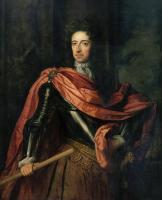
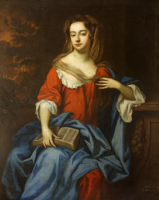
On 15th April 1692 Henry Harrison was hanged for the murder of Andrew Clench.
Calendar of the State Papers of William and Mary 1693 April. 15th April 1693. Whitehall. Commission for Thomas Wilson, gent., to be Leutenant to Capt. Hillis Cooper, in the first marine regiment of foot, commanded by Peregrine, Earl of Danby [aged 34]. [H.O. Military Entry Book 2, p. 358.]
Calendar of the State Papers of William and Mary 1693 April. 15th April 1693. Whitehall. Commission for James Brough, gent., to be lieutenant to Capt. Percy Kirke in the first marine regiment of foot, commanded by Peregrine, Earl of Danby [aged 34]. [Ibid., p. 363.]
On 15th April 1699 Susan Murray was born to John Murray 1st Duke Atholl [aged 39] and Catherine Hamilton Duchess Atholl [aged 37]. She married after 1710 William Gordon 2nd Earl Aberdeen, son of George Gordon 1st Earl Aberdeen, and had issue.
On 15th April 1703 Charles Hope 1st Earl Hopetoun [aged 22] was created 1st Earl Hopetoun by Queen Anne of England Scotland and Ireland [aged 38] in recognition of his father having given up his seat in a lifeboat to the Duke of York during the Sinking of the Gloucester; his father subsequently drowned.
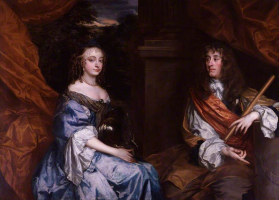


On 15th April 1757 Rosalba Carrera [aged 84] died.

On 15th April 1761 Archibald Campbell 3rd Duke Argyll [aged 78] died. His first cousin John [aged 68] succeeded 4th Duke Argyll.

On 15th April 1822 Frances Anne Emily Vane Duchess of Marlborough was born to Charles William Vane 3rd Marquess Londonderry [aged 44] and Frances Vane Tempest Marchioness Londonderry [aged 22]. She married 12th July 1843 John Winston Spencer-Churchill 7th Duke of Marlborough, son of George Spencer-Churchill 6th Duke of Marlborough and Jane Stewart Duchess of Marlborough, and had issue.
Chronicle of a Bourgeois of Valenciennes
Récits d’un bourgeois de Valenciennes aka The Chronicle of a Bourgeois of Valenciennes is a vivid 14th-century vernacular chronicle written by an anonymous urban chronicler from Valenciennes in the County of Hainaut. It survives in a manuscript that describes local and regional history from about 1253 to 1366, blending chronology, narrative episodes, and eyewitness-style accounts of political, military, and social events in medieval France, Flanders, and the Low Countries. The work begins with a chronological framework of events affecting Valenciennes and its region under rulers such as King Philip VI of France and the shifting allegiances of local nobility. It includes accounts of conflicts, sieges, diplomatic manoeuvres, and the impact of broader struggles like the Hundred Years’ War on urban life in Hainaut. Written from the perspective of a burgher (bourgeois) rather than a monastery or royal court, the chronicle offers a rare lay viewpoint on high politics and warfare, reflecting how merchants, townspeople, and civic institutions experienced the turbulence of the 13th and 14th centuries. Its narrative style combines straightforward reporting of events with moral and civic observations, making it a valuable source for readers interested in medieval urban society, regional politics, and the lived experience of war and governance in pre-modern Europe.
Available at Amazon in eBook and Paperback format.

On 15th April 1824 Edward Buller 1st Baronet [aged 59] died. Baronet Buller of Trennant Park in Cornwall extinct. He was buried at St Cuby's Church, Duloe [Map].
Edward Buller 1st Baronet: On 24th December 1764 he was born to John Buller and Mary St Aubyn. On 3rd October 1808 Edward Buller 1st Baronet was created 1st Baronet Buller of Trennant Park in Cornwall.
On 15th April 1827 Caroline Leveson-Gower Duchess Leinster was born to George Sutherland Leveson-Gower 2nd Duke Sutherland [aged 40] and Harriet Elizabeth Georgiana Howard Duchess Sutherland [aged 20]. Coefficient of inbreeding 3.22%. She married 12th October 1847 her half fifth cousin once removed Charles William Fitzgerald Fitzgerald 4th Duke Leinster, son of Augustus Fitzgerald 3rd Duke Leinster and Charlotte Augusta Stanhope Duchess Leinster, and had issue.


On 15th April 1828 Caroline Stolberg Gedern Duchess Veragua Duchess Berwick [aged 73] died.
On 15th April 1840 William Amelius Aubrey Beauclerk 10th Duke St Albans was born to William Beauclerk 9th Duke St Albans [aged 39] and Elizabeth Catherine Gubbins Duchess St Albans [aged 22]. He a great x 4 grandson of King Charles II of England Scotland and Ireland. He married (1) 20th June 1867 his fourth cousin Sybil Mary Grey Duchess St Albans and had issue (2) 3rd January 1874 Grace Bernal Duchess St Albans and had issue.
On 7th April 1854 Catherine Louise Georgina Marlay [aged 23] died from childbirth three weeks after giving birth to her daughter Edith Katherine Manners [deceased] who had died at twelve days old. She was buried at Highgate Cemetery on 15th April 1854. Monument by William Calder Marshall [aged 41] erected in 1862 in a chapel at St Katherine's Church, Rowsley [Map] built for the purpose commissioned by her husband John Manners [aged 35], the future 7th Duke of Rutland.




On 15th April 1897 Blanche Linnie Fitzroy Countess St Germans was born to Henry Adelbert Wellington Fitzroy 9th Duke Beaufort [aged 49] and Louise Emily Harford 9th Duchess Beaufort [aged 32]. She married 11th June 1918 her third cousin once removed John Granville Cornwallis Eliot 6th Earl St Germans, son of Henry Cornwallis Eliot 5th Earl St Germans and Emily Harriet Labouchere Countess St Germans, and had issue.
On 15th April 1912 Tyrell William Cavendish [aged 36] drowned during the Sinking of the Titanic. His wife Julia Florence Siegel [aged 25] and her maid Ellen survived the disaster. She later recalled: "I was in the second boat. My husband kissed me and bade me remain in the boat, declaring he was all right. There was no light, but the sky was clear. Bright skies illuminated the scene of the disaster. Just as the lifeboat was lowered I again kissed my husband. He assured me he would rather stay on the boat, thinking he would be safe... As the boat reached the water there were twenty-three women in the boat and two men to guide and row her. Many of us women implored men on the upper deck to come to our succour, but most of them said they could not row. One man there was about to get in the boat, but a sailor, after questioning him threw him aside. A Canadian, who stated that he could row turned to a group of men on the deck who were watching the proceedings and said: 'I can row, but if there is room for one more let it be a woman.'"
On 15th April 1912 Hugh Woolner [aged 46] was aboard the Titanic when it sank; he survived.
After 15th April 1912. Grave at St Mary's Church, Tissington [Map] of Richard Allsop, and his sons James and Frank Richard, and James, the last of whom drowned on the Titanic


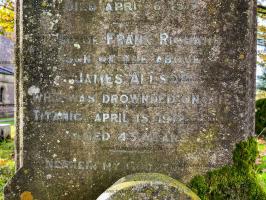

On 15th April 1915 Joseph Herbert Abbott [aged 38] enlisted in the Northamptonshire Regiment. He is described as 36 years old, and an engine driver.
Joseph Herbert Abbott: In 1877 he was born to Thomas Abbott and Jane Ginn at Polebrook, Northamptonshire. On 11th November 1918 he died of sickness.
On 15th April 1915 Roland James Corbet 5th Baronet [aged 22] was killed in action. His uncle Gerald [aged 47] succeeded 6th Baronet Corbet of Moreton Corbet in Shropshire.
Jean de Waurin's Chronicle of England Volume 6 Books 3-6: The Wars of the Roses
Jean de Waurin was a French Chronicler, from the Artois region, who was born around 1400, and died around 1474. Waurin’s Chronicle of England, Volume 6, covering the period 1450 to 1471, from which we have selected and translated Chapters relating to the Wars of the Roses, provides a vivid, original, contemporary description of key events some of which he witnessed first-hand, some of which he was told by the key people involved with whom Waurin had a personal relationship.
Available at Amazon in eBook and Paperback format.
On 15th April 1927 Henry Holiday [aged 87] died.
On 15th April 1937 Conrad Russell 5th Earl Russell was born to Bertrand Russell 3rd Earl Russell [aged 64].

On 15th April 1969 Victoria Eugénie Mountbatten Queen Consort Spain [aged 81] died.
On 15th April 1282 Frederick "Fighter" Metz IV Duke Lorraine was born to Theobald Metz II Duke Lorraine [aged 19] and Isabelle Lady Rumigny Duchess Lorraine. He married 1304 Elizabeth Habsburg Duchess Lorraine, daughter of Albert Habsburg I Duke Austria and Elizabeth Carinthia Duchess Austria, and had issue.
On 15th April 1367 King Henry IV of England was born to John of Gaunt 1st Duke Lancaster [aged 27] and Blanche Duchess of Lancaster [aged 25] at Bolingbroke Castle, Lincolnshire [Map]. He a grandson of King Edward III of England. He married (1) 5th February 1381 his second cousin Mary Bohun, daughter of Humphrey Bohun 7th Earl Hereford 6th Earl Essex 2nd Earl of Northampton and Joan Fitzalan Countess Essex, Hereford and Northampton, and had issue (2) 7th February 1403 his third cousin Joanna of Navarre Queen Consort England, daughter of Charles "Bad" II King Navarre and Joan Valois Queen Consort Navarre.
On 15th April 1479 Joanna Trastámara Queen Consort Naples was born to Ferdinand I King Naples [aged 55] and Joanna of Aragon Queen Consort Naples [aged 25]. Coefficient of inbreeding 7.30%. She married 1496 her nephew Ferdinand II King Naples.
On 15th April 1646 Christian V King of Denmark and Norway was born to Frederick III King of Denmark [aged 37] and Sophie Amalie Hanover Queen Consort Denmark [aged 18]. He married 15th June 1667 his fourth cousin Charlotte Amalie Hesse-Kassel Queen Consort Denmark and Norway, daughter of Wilhelm "The Just" VI Hesse-Kassel and Hedwig Sophia Hohenzollern, and had issue.
On 15th April 1668 Nicholas Barnewall 3rd Viscount Barnewall was born to Henry Barnewall 2nd Viscount Barnewall and Mary Nugent Viscountess Barnewall [aged 20]. He married 1688 Mary Hamilton Viscountess Barnewall.
On 15th April 1677 Barbara Coningsby was born to Thomas Coningsby 1st Earl Coningsby [aged 20] and Barbara Gorges [aged 20]. She married 8th September 1702 George Eyre.
On 15th April 1690 John Wallop 1st Earl Portsmouth was born to John Wallop of Farleigh Wallop [aged 30] and Alicia Borlase. He married (1) 20th May 1716 Bridget Bennet Viscountess Lymington, daughter of Charles Bennet 1st Earl Tankerville and Mary Grey Baroness Ossulston, and had issue (2) 9th June 1741 his fifth cousin once removed Elizabeth Griffin Countess Portsmouth, daughter of James Griffin 2nd Baron Griffin.
On 15th April 1699 Susan Murray was born to John Murray 1st Duke Atholl [aged 39] and Catherine Hamilton Duchess Atholl [aged 37]. She married after 1710 William Gordon 2nd Earl Aberdeen, son of George Gordon 1st Earl Aberdeen, and had issue.
On 15th April 1715 James Annesley was born to Arthur Annesley 4th Baron Altham [aged 26] and Mary Sheffield Baroness Altham [aged 23] at Dunmaine. At some time after his birth his father threw his mother out of the house apparently for infidelity. His father also rejected James who, thereafter, was homeless.
Abbot John Whethamstede’s Chronicle of the Abbey of St Albans
Abbot John Whethamstede's Register aka Chronicle of his second term at the Abbey of St Albans, 1451-1461, is a remarkable text that describes his first-hand experience of the beginning of the Wars of the Roses including the First and Second Battles of St Albans, 1455 and 1461, respectively, their cause, and their consequences, not least on the Abbey itself. His text also includes Loveday, Blore Heath, Northampton, the Act of Accord, Wakefield, and Towton, and ends with the Coronation of King Edward IV. In addition to the events of the Wars of the Roses, Abbot John, or his scribes who wrote the Chronicle, include details in the life of the Abbey such as charters, letters, land exchanges, visits by legates, and disputes, which provide a rich insight into the day-to-day life of the Abbey, and the challenges faced by its Abbot.
Available at Amazon in eBook and Paperback format.
On 15th April 1723 James Tuchet 7th Earl Castlehaven was born to James Tuchet 6th Earl Castlehaven and Elizabeth Arundell Countess Castlehaven [aged 30].
On 15th April 1723 Lepell Hervey Baroness Mulgrave was born to John Hervey 2nd Baron Hervey [aged 26] and Mary Lepell Baroness Hervey [aged 23]. She married 26th February 1743 Constantine Phipps 1st Baron Mulgrave and had issue.


On 15th April 1732 Susanna Hoare Countess Ailesbury was born to Henry Hoare "The Magnificient" [aged 26] and Susan Colt. She married 17th February 1761 Thomas Brudenell 1st Earl Ailesbury, son of George Brudenell 3rd Earl Cardigan and Elizabeth Bruce 3rd Countess Cardigan, and had issue.
On 15th April 1772 Francis Charteris 8th Earl of Wemyss Douglas 4th Earl March was born to Francis Wemyss Douglas [aged 23]. He married 31st May 1794 his fifth cousin once removed Margaret Campbell of Shawfield.

On 15th April 1787 Henry St John-Mildmay 4th Baronet was born to Henry Paulet St John-Mildmay 3rd Baronet [aged 22] and Jane Mildmay Lady St-John Mildmay [aged 22]. He married (1) 7th August 1809 Charlotte Bouverie and had issue (2) 1815 Harriett Bouverie Countess Camden and had issue.
On 15th April 1795 Harriet Molyneux Lady Phillipps was born to General Thomas Molyneau 5th Baronet [aged 28] and Elizabeth Perrin Lady Molyneux [aged 26]. She married 1819 Thomas Phillipps 1st Baronet.
On 15th April 1805 Anna Frances Esther Stapleton was born to Thomas Stapleton 12th Baron Despencer [aged 38] and Elizabeth Eliot Baroness Despencer [aged 47]. She married 3rd December 1828 Henry Maxwell 7th Baron Farnham.
On 15th April 1809 Dean Thomas Garnier was born to Thomas Garnier [aged 33]. He married before 22nd February 1841 Caroline Elizabeth Keppel, daughter of William Charles Keppel 4th Earl Albermarle and Elizabeth Southwell Countess Albermarle, and had issue.
On 15th April 1811 Mary Marsham was born to Charles Marsham 2nd Earl Romney [aged 33] and Sophia Pitt Countess Romney. She married 1836 Henry Hoare of Staplehurst and had issue.
On 15th April 1822 Frances Anne Emily Vane Duchess of Marlborough was born to Charles William Vane 3rd Marquess Londonderry [aged 44] and Frances Vane Tempest Marchioness Londonderry [aged 22]. She married 12th July 1843 John Winston Spencer-Churchill 7th Duke of Marlborough, son of George Spencer-Churchill 6th Duke of Marlborough and Jane Stewart Duchess of Marlborough, and had issue.
Anne Boleyn. Her Life as told by Lancelot de Carle's 1536 Letter.
In 1536, two weeks after the execution of Anne Boleyn, her brother George and four others, Lancelot du Carle, wrote an extraordinary letter that described Anne's life, and her trial and execution, to which he was a witness. This book presents a new translation of that letter, with additional material from other contemporary sources such as Letters, Hall's and Wriothesley's Chronicles, the pamphlets of Wynkyn the Worde, the Memorial of George Constantyne, the Portuguese Letter and the Baga de Secrets, all of which are provided in Appendices.
Available at Amazon in eBook and Paperback format.
On 15th April 1822 Percy Egerton Herbert was born to Edward Herbert 2nd Earl Powis [aged 37] and Lucy Graham Countess Powis [aged 28] at Powis Castle [Map]. He married 4th October 1860 his fourth cousin twice removed Mary Caroline Louisa Petty Fitzmaurice and had issue.



On 15th April 1825 Frederica Berkeley Baroness Gifford was born to Admiral Maurice Berkeley 1st Baron FitzHardinge [aged 37] and Charlotte Lennox [aged 21]. She a great x 4 granddaughter of King Charles II of England Scotland and Ireland. She married 1st April 1845 Robert Gifford 2nd Baron Gifford, son of Robert Gifford 1st Baron Gifford, and had issue.
On 15th April 1827 Caroline Leveson-Gower Duchess Leinster was born to George Sutherland Leveson-Gower 2nd Duke Sutherland [aged 40] and Harriet Elizabeth Georgiana Howard Duchess Sutherland [aged 20]. Coefficient of inbreeding 3.22%. She married 12th October 1847 her half fifth cousin once removed Charles William Fitzgerald Fitzgerald 4th Duke Leinster, son of Augustus Fitzgerald 3rd Duke Leinster and Charlotte Augusta Stanhope Duchess Leinster, and had issue.
On 15th April 1832 William Keppel 7th Earl Albermarle was born to George Thomas Keppel 6th Earl Albermarle [aged 32]. He a great x 4 grandson of King Charles II of England Scotland and Ireland. He married 15th November 1855 Sophia Mary MacNab of Dundurn Castle, daughter of Colonel Allan Napier MacNab 1st Baronet and Mary Elizabeth Stuart, and had issue.
On 15th April 1836 Captain George Fitz-Clarence was born to George Fitz-Clarence 1st Earl Munster [aged 42] and Mary Wyndham Countess Munster [aged 43]. He a grandson of King William IV of the United Kingdom. He married before 8th May 1865 Maria Henrietta Scott and had issue.
On 15th April 1840 William Amelius Aubrey Beauclerk 10th Duke St Albans was born to William Beauclerk 9th Duke St Albans [aged 39] and Elizabeth Catherine Gubbins Duchess St Albans [aged 22]. He a great x 4 grandson of King Charles II of England Scotland and Ireland. He married (1) 20th June 1867 his fourth cousin Sybil Mary Grey Duchess St Albans and had issue (2) 3rd January 1874 Grace Bernal Duchess St Albans and had issue.
On 15th April 1843 Edward John Hanmer 5th Baronet was born to Wyndham Hamner 4th Baronet [aged 33].
On 15th April 1857 John William Honywood 8th Baronet was born to Courtenay Honywood 7th Baronet [aged 22].
On 15th April 1881 Gervas Pierrepont 6th Earl Manvers was born to Evelyn Henry Pierrepont [aged 25] and Sophia.
On 15th April 1887 Evelyn Maud Keppel Countess Lichfield was born to Edward George Keppel [aged 39]. She married 11th July 1911 her fourth cousin once removed Thomas Edward Anson 4th Earl Lichfield, son of Thomas Francis Anson 3rd Earl Lichfield and Mildred Coke Countess Lichfield, and had issue.
On 15th April 1887 Roundell Palmer 3rd Earl Selborne was born to William Palmer 2nd Earl Selborne [aged 27] and Beatrix Maud Gascoyne-Cecil Countess Selborne [aged 29]. He married 9th June 1910 Grace Ridley Countess Selborne, daughter of Matthew White Ridley 1st Viscount Ridley, and had issue.


On 15th April 1887 Violet Asquith was born to Herbert Henry Asquith 1st Earl of Oxford and Asquith [aged 34] and Helen Kelsall Melland [aged 33]. She married 30th November 1915 Maurice Bonham-Carter.
On 15th April 1889 Reginald Frankland Payne-Gallwey 5th Baronet was born to Wyndham Harry Payne-Gallwey [aged 33].
On 15th April 1891 William Joshua Rowley 6th Baronet was born to George Charles Erskine Rowley 3rd Baronet [aged 46].
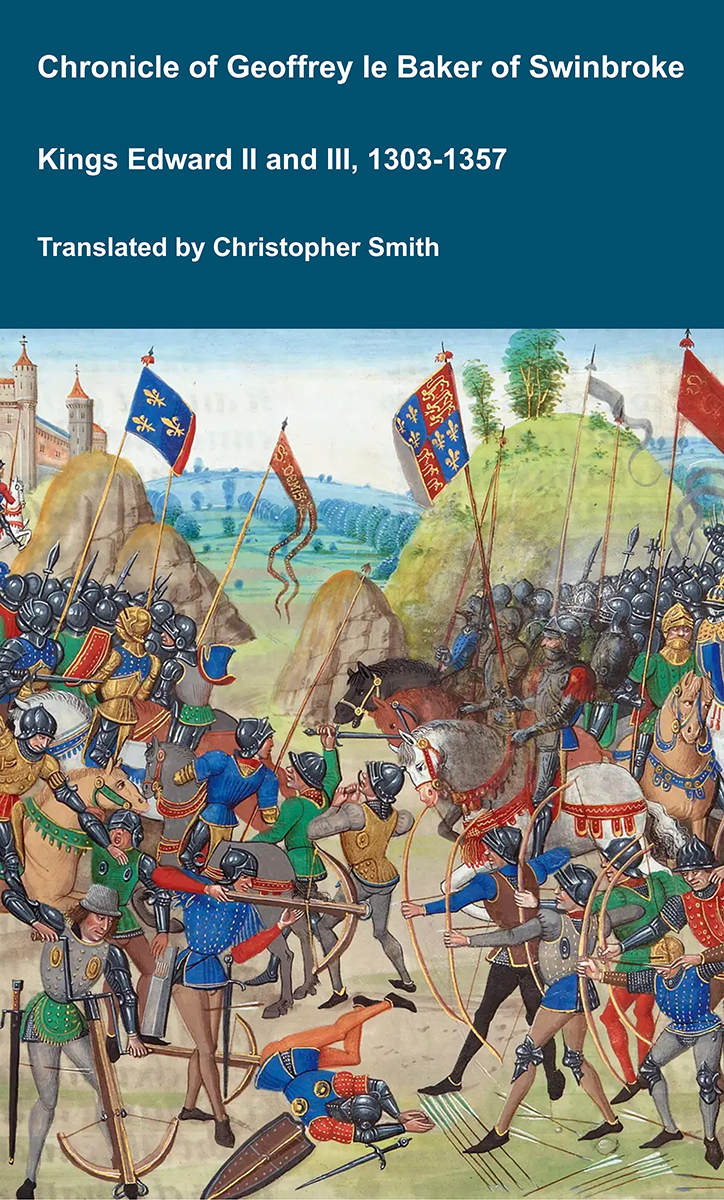
Chronicle of Geoffrey le Baker of Swinbroke
Baker was a secular clerk from Swinbroke, now Swinbrook, an Oxfordshire village two miles east of Burford. His Chronicle describes the events of the period 1303-1356: Gaveston, Bannockburn, Boroughbridge, the murder of King Edward II, the Scottish Wars, Sluys, Crécy, the Black Death, Winchelsea and Poitiers. To quote Herbert Bruce 'it possesses a vigorous and characteristic style, and its value for particular events between 1303 and 1356 has been recognised by its editor and by subsequent writers'. The book provides remarkable detail about the events it describes. Baker's text has been augmented with hundreds of notes, including extracts from other contemporary chronicles, such as the Annales Londonienses, Annales Paulini, Murimuth, Lanercost, Avesbury, Guisborough and Froissart to enrich the reader's understanding. The translation takes as its source the 'Chronicon Galfridi le Baker de Swynebroke' published in 1889, edited by Edward Maunde Thompson.
Available at Amazon in eBook and Paperback format.
On 15th April 1895 Helen Plunket was born to William Plunket 5th Baron Plunket [aged 30] and Victoria Hamilton-Temple-Blackwood Baroness Plunket. She married 24th January 1916 Arthur Tahu Gravenor Rhodes.
On 15th April 1897 Blanche Linnie Fitzroy Countess St Germans was born to Henry Adelbert Wellington Fitzroy 9th Duke Beaufort [aged 49] and Louise Emily Harford 9th Duchess Beaufort [aged 32]. She married 11th June 1918 her third cousin once removed John Granville Cornwallis Eliot 6th Earl St Germans, son of Henry Cornwallis Eliot 5th Earl St Germans and Emily Harriet Labouchere Countess St Germans, and had issue.
On 15th April 1898 Gerard Foley 7th Baron Foley was born to Henry St George Foley [aged 31] and Mary Adelaide Agar [aged 28].
On 15th April 1910 Ralph Grey 1st Baron Grey of Naunton was born.
On 15th April 1913 Margaret Lane-Fox was born to George Lane-Fox 1st Baron Bingley [aged 42] and Mary Agnes Emily Wood Baroness Bingley [aged 36].
On 15th April 1927 Sacheverell Reresby Sitwell 7th Baronet was born to Sacheverell Reresby Sitwell 6th Baronet [aged 29] and Georgia Doble [aged 21]. He married 31st October 1952 Penelope Forbes and had issue.



On 15th April 1937 Conrad Russell 5th Earl Russell was born to Bertrand Russell 3rd Earl Russell [aged 64].
On 15th April 1945 Anthony Oliver Thorold 16th Baronet was born to Anthony Henry Thorold 15th Baronet [aged 41] and Jocelyn Elaine Laura Heathcote-Smith.
On 15th April 1951 Claire Anabel Margaret Kerr was born to Peter Francis Walter Kerr 12th Marquess Lothian [aged 28]. She married James Oliver Charles Fitzroy, son of Hugh Denis Charles Fitzroy 11th Duke Grafton and Ann Fortune Smith Duchess Grafton, and had issue.
On 15th April 1650 Anthony Ashley-Cooper 1st Earl Shaftesbury [aged 28] and Frances Cecil [aged 17] were married. She the daughter of David Cecil 3rd Earl Exeter and Elizabeth Egerton Countess Exeter.


Chronicle of Walter of Guisborough
A canon regular of the Augustinian Guisborough Priory, Yorkshire, formerly known as The Chronicle of Walter of Hemingburgh, describes the period from 1066 to 1346. Before 1274 the Chronicle is based on other works. Thereafter, the Chronicle is original, and a remarkable source for the events of the time. This book provides a translation of the Chronicle from that date. The Latin source for our translation is the 1849 work edited by Hans Claude Hamilton. Hamilton, in his preface, says: 'In the present work we behold perhaps one of the finest samples of our early chronicles, both as regards the value of the events recorded, and the correctness with which they are detailed; Nor will the pleasing style of composition be lightly passed over by those capable of seeing reflected from it the tokens of a vigorous and cultivated mind, and a favourable specimen of the learning and taste of the age in which it was framed.'
Available at Amazon in eBook and Paperback format.
On 15th April 1680 Bryan Stapylton 2nd Baronet [aged 22] and Anne Kaye Lady Stapylton were married. She by marriage Lady Stapylton Stapleton of Myton in Yorkshire.

On 15th April 1698 James Bertie 1st Earl of Abingdon [aged 44] and Catherine Chamberlayne Countess Abingdon [aged 30] were married at the Church of St Mary the Virgin, Stanwell. She by marriage Countess Abingdon. He the son of Montagu Bertie 2nd Earl Lindsey and Bridget Wray Countess Lindsey.
On 15th April 1702 Orlando Bridgeman 2nd Baronet [aged 23] and Susanna Dashwood Lady Bridgeman [aged 17] were married. She by marriage Lady Bridgeman of Ridley in Cheshire.
On 15th April 1759 John Evans 5th Baron Carbery [aged 21] and Emilia Crowe Baroness Carbery were married. They were first cousin once removed.
On 15th April 1778 William Strickland 6th Baronet [aged 25] and Henrietta Cholmley Lady Strickland [aged 17] were married. They were sixth cousins.
On 15th April 1822 Pownoll Bastard Pellew 2nd Viscount Exmouth [aged 35] and Georgiana Janet Dick Viscountess Pellew [aged 22] were married.
On 15th April 1828 John Wilson aka Wilson-Patten 1st Baron Winmarleigh [aged 25] and Anna Maria Patten-Bold [aged 27] were married. They were first cousins.
On 15th April 1833 Samuel John Brooke-Pechell 3rd Baronet [aged 47] and Julia Maria Petre Lady Brooke-Pechell [aged 43] were married at her mother's [aged 63] house in Grosvenor Square, Belgravia. She by marriage Lady Brooke-Pechell of Paglesham in Essex.
On 15th April 1847 Henry Vivian 1st Baron Swansea [aged 25] and Jessie Dalrymple Goddard [aged 22] were married.
On 15th April 1858 Arthur Edwin Hill aka Hill-Trevor 1st Baron Trevor [aged 38] and Mary Catherine Curzon Baroness Trevor [aged 20] were married. He the son of Arthur Blundell Sandys Trumbull Hill 3rd Marquess Downshire and Maria Windsor Marchioness Downshire.
Annals of the six Kings of England by Nicholas Trivet
Translation of the Annals of the Six Kings of England by that traces the rise and rule of the Angevin aka Plantagenet dynasty from the mid-12th to early 14th century. Written by the Dominican scholar Nicholas Trivet, the work offers a vivid account of English history from the reign of King Stephen through to the death of King Edward I, blending political narrative with moral reflection. Covering the reigns of six monarchs—from Stephen to Edward I—the chronicle explores royal authority, rebellion, war, and the shifting balance between crown, church, and nobility. Trivet provides detailed insight into defining moments such as baronial conflicts, Anglo-French rivalry, and the consolidation of royal power under Edward I, whose reign he describes with particular immediacy. The Annals combines careful year-by-year reporting with thoughtful interpretation, presenting history not merely as a sequence of events but as a moral and political lesson. Ideal for readers interested in medieval history, kingship, and the origins of the English state, this chronicle remains a valuable and accessible window into the turbulent world of the Plantagenet kings.
Available at Amazon in eBook and Paperback format.
On 15th April 1909 Albert Archibald Primrose 6th Earl Rosebery 2nd Earl Midlothian [aged 27] and Dorothy Grosvenor [aged 18] were married. He the son of Archibald Philip Primrose 5th Earl Rosebery 1st Earl Midlothian [aged 61] and Hannah Rothschild Countess of Rosebery.
On 15th April 1053 Godwin 1st Earl Kent and Wessex [aged 52] died. His son Leofwine [aged 18] succeeded 2nd Earl Kent. His son Harold Godinson [aged 31] succeeded 2nd Earl Wessex.
On 15th April 1136 Richard de Clare was killed. His son Gilbert [aged 21] succeeded 4th Lord Tonbridge.
On 15th April 1237 Bishop Richard Poore died.
On 15th April 1322 Idonea Leybourne Baroness Say [aged 41] died at Leybourne Manor, Malling, Kent.
On 15th April 1389 William Wittelsbach I Duke Lower Bavaria [aged 58] died.
On 15th April 1393 Elizabeth Pomerania Holy Roman Empress Luxemburg [aged 46] died.
On 15th April 1570 Bishop William Alley [aged 60] died.

On 9th March 1589 Frances Sidney Countess Sussex [aged 58] died. On 15th April 1589 she was buried in Chapel of St Paul, Westminster Abbey [Map].
On 15th April 1632 George Calvert 1st Baron Baltimore [aged 52] died. His son Cecil [aged 26] succeeded 2nd Baron Baltimore of Longford in Leinster. Ann Arundell Baroness Baltimore [aged 16] by marriage Baroness Baltimore of Longford in Leinster.
On 15th April 1633 Colin Mackenzie 1st Earl Seaforth died.
Abbot John Whethamstede’s Chronicle of the Abbey of St Albans
Abbot John Whethamstede's Register aka Chronicle of his second term at the Abbey of St Albans, 1451-1461, is a remarkable text that describes his first-hand experience of the beginning of the Wars of the Roses including the First and Second Battles of St Albans, 1455 and 1461, respectively, their cause, and their consequences, not least on the Abbey itself. His text also includes Loveday, Blore Heath, Northampton, the Act of Accord, Wakefield, and Towton, and ends with the Coronation of King Edward IV. In addition to the events of the Wars of the Roses, Abbot John, or his scribes who wrote the Chronicle, include details in the life of the Abbey such as charters, letters, land exchanges, visits by legates, and disputes, which provide a rich insight into the day-to-day life of the Abbey, and the challenges faced by its Abbot.
Available at Amazon in eBook and Paperback format.
On 15th April 1683 Clement Fisher 2nd Baronet [aged 70] died. His nephew Clement [aged 8] succeeded 3rd Baronet Fisher of Packington Magna.
On 15th April 1716 Anne Churchill Countess Sunderland [aged 33] died.
On 15th April 1721 Thomas Domvile 1st Baronet [aged 66] died. His son Compton [aged 25] succeeded 2nd Baronet Domvile of Templeogue.
On 15th April 1723 Alice Wyndham Lady Knatchbull [aged 47] died.
On 15th April 1727 George Compton 4th Earl of Northampton [aged 62] died. His son James [aged 39] succeeded 5th Earl of Northampton. Elizabeth Shirley Countess Northampton [aged 32] by marriage Countess of Northampton.


On 15th April 1736 Henrietta Douglas Lady Grierson [aged 79] died at Turnpike House in Dumfries.
On 15th April 1757 Rosalba Carrera [aged 84] died.
On 15th April 1761 Archibald Campbell 3rd Duke Argyll [aged 78] died. His first cousin John [aged 68] succeeded 4th Duke Argyll.
On 15th April 1762 Edward Dering 5th Baronet [aged 57] died. He was buried at St Nicholas' Church, Pluckley on 22nd April 1762. His son Edward [aged 29] succeeded 6th Baronet Dering of Surrenden Dering in Kent.
On 15th April 1778 Sarah Webster Lady Raymond [aged 55] died.
Abbot John Whethamstede’s Chronicle of the Abbey of St Albans
Abbot John Whethamstede's Register aka Chronicle of his second term at the Abbey of St Albans, 1451-1461, is a remarkable text that describes his first-hand experience of the beginning of the Wars of the Roses including the First and Second Battles of St Albans, 1455 and 1461, respectively, their cause, and their consequences, not least on the Abbey itself. His text also includes Loveday, Blore Heath, Northampton, the Act of Accord, Wakefield, and Towton, and ends with the Coronation of King Edward IV. In addition to the events of the Wars of the Roses, Abbot John, or his scribes who wrote the Chronicle, include details in the life of the Abbey such as charters, letters, land exchanges, visits by legates, and disputes, which provide a rich insight into the day-to-day life of the Abbey, and the challenges faced by its Abbot.
Available at Amazon in eBook and Paperback format.
On 15th April 1787 William Boothby 4th Baronet [aged 65] died unmarried. His first cousin once removed Brooke [aged 76] succeeded 5th Baronet Boothby of Broadlow Ash in Derbyshire. Phoebe Hollins Lady Boothby [aged 70] by marriage Lady Boothby of Broadlow Ash in Derbyshire.
Mary Thorpe 14th Baroness Cobham [aged 70] de jure 14th Baroness Cobham although the title remained subject to an attainder so she couldn't claim it.
On 15th April 1805 George Carpenter 2nd Earl Tyrconnel [aged 55] died. His nephew George [aged 17] succeeded 3rd Earl Tyrconnel, 5th Baron Carpenter of Killaghy in County Tipperary.
On 15th April 1824 Edward Buller 1st Baronet [aged 59] died. Baronet Buller of Trennant Park in Cornwall extinct. He was buried at St Cuby's Church, Duloe [Map].
Edward Buller 1st Baronet: On 24th December 1764 he was born to John Buller and Mary St Aubyn. On 3rd October 1808 Edward Buller 1st Baronet was created 1st Baronet Buller of Trennant Park in Cornwall.
On 15th April 1828 Sarah Yonge Countess Nelson [aged 79] died.
On 15th April 1828 Caroline Stolberg Gedern Duchess Veragua Duchess Berwick [aged 73] died.
On 15th April 1846 John Saunders Sebright 7th Baronet [aged 78] died. His son Thomas [aged 44] succeeded 8th Baronet Sebright of Besford in Worcestershire.
On 15th April 1850 John Edwards 1st Baronet [aged 80] died. He had no male heirs so Baronet Edwards of Garth in Montgomeryshire extinct.
On 7th April 1854 Catherine Louise Georgina Marlay [aged 23] died from childbirth three weeks after giving birth to her daughter Edith Katherine Manners [deceased] who had died at twelve days old. She was buried at Highgate Cemetery on 15th April 1854. Monument by William Calder Marshall [aged 41] erected in 1862 in a chapel at St Katherine's Church, Rowsley [Map] built for the purpose commissioned by her husband John Manners [aged 35], the future 7th Duke of Rutland.
On 15th April 1856 George Augustus Frederick Cowper 6th Earl Cowper [aged 49] died. His son Francis [aged 21] succeeded 7th Earl Cowper, 6th Baron Cowper of Wingham in Kent, 8th Baronet Cowper of Ratling Court in Kent.
On 15th April 1914 John William Ramsden 5th Baronet [aged 82] died. His son John [aged 37] succeeded 6th Baronet Ramsden of Byram in Yorkshire. Joan Buxton Lady Ramsden [aged 33] by marriage Lady Ramsden of Byram in Yorkshire.

On 15th April 1914 Delves Louis Broughton 10th Baronet [aged 56] died. His son John [aged 30] succeeded 11th Baronet Broughton of Broughton in Staffordshire. Vera Edyth Griffith-Boscawen Lady Boughton [aged 20] by marriage Lady Broughton of Broughton in Staffordshire.
On 15th April 1915 Roland James Corbet 5th Baronet [aged 22] was killed in action. His uncle Gerald [aged 47] succeeded 6th Baronet Corbet of Moreton Corbet in Shropshire.
On 15th April 1925 Florence Hamilton Davis Countess Howe [aged 55] died.
Chronicle of Walter of Guisborough
A canon regular of the Augustinian Guisborough Priory, Yorkshire, formerly known as The Chronicle of Walter of Hemingburgh, describes the period from 1066 to 1346. Before 1274 the Chronicle is based on other works. Thereafter, the Chronicle is original, and a remarkable source for the events of the time. This book provides a translation of the Chronicle from that date. The Latin source for our translation is the 1849 work edited by Hans Claude Hamilton. Hamilton, in his preface, says: 'In the present work we behold perhaps one of the finest samples of our early chronicles, both as regards the value of the events recorded, and the correctness with which they are detailed; Nor will the pleasing style of composition be lightly passed over by those capable of seeing reflected from it the tokens of a vigorous and cultivated mind, and a favourable specimen of the learning and taste of the age in which it was framed.'
Available at Amazon in eBook and Paperback format.
On 15th April 1927 Henry Holiday [aged 87] died.
On 15th April 1932 Annie Cass Viscountess Cowdray [aged 71] died.
On 15th April 1943 Louisa Hazel Agnew Viscountess Combermere [aged 51] died.
On 15th April 1969 Victoria Eugénie Mountbatten Queen Consort Spain [aged 81] died.
On 15th April 1973 John Grimston 6th Earl of Verulam [aged 60] died. His son John [aged 21] succeeded 7th Earl Verulam, 7th Viscount Grimston, 10th Viscount Grimston, 8th Baron Verulam of Gorhambury in Hertfordshire, 14th Baronet Grimston of Little Waltham in Essex.
On 15th April 2014 Gilbert Simon Heathcote 9th Baronet died. His son Mark [aged 73] succeeded 10th Baronet Heathcote of London
On 15th April 2020 Elizabeth Lumley Baroness Grimthorpe [aged 94] died.